Rhassoul clay COA and heavy metals test
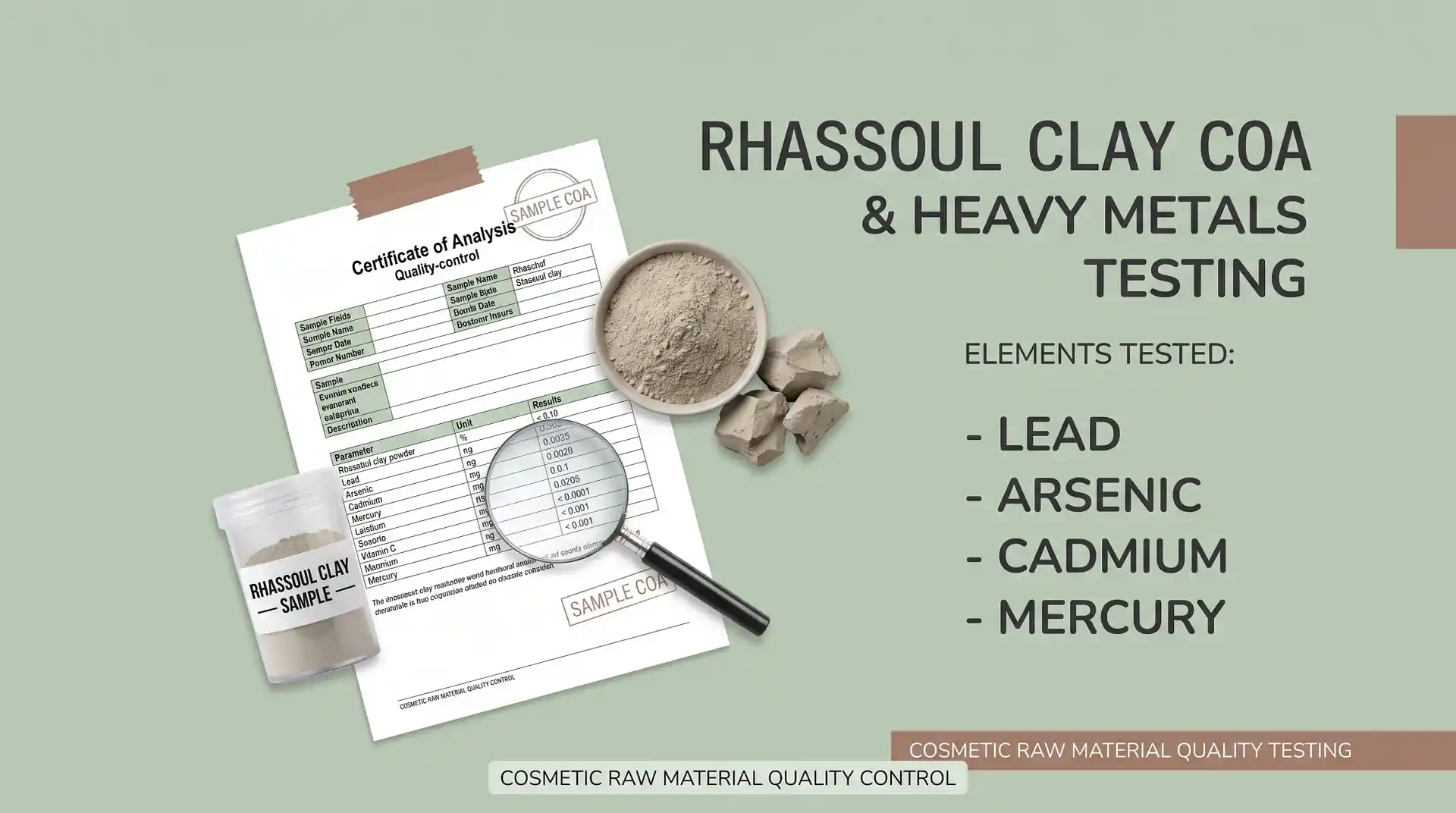
Rhassoul clay—also known as Ghassoul or Moroccan Hectorite clay—has earned a global reputation as an exceptionally purifying, mineral-rich ingredient for skin and hair care. Formed over tens of millions of years through volcanic activity and geothermal alteration in Morocco's Atlas Mountain region, this unique clay possesses natural saponins, high absorption capacity, and high levels of silica and magnesium. However, because all naturally mined earth clays originate from geological deposits, they inherently contain trace amounts of heavy metals derived from the Earth's crust.
For cosmetic formulators, brand owners, regulatory officers, and safety-conscious consumers, verifying the chemical safety of raw clay is paramount. Evaluating a Certificate of Analysis (COA) and a comprehensive heavy metals test report is the single most important step in ensuring that a batch of Rhassoul clay complies with international cosmetic safety regulations, such as those established by the European Union and the United States Food and Drug Administration.
This guide explains the chemistry behind natural clay deposits, breaks down how heavy metals are tested, outlines standard safety thresholds, and provides a clear methodology for interpreting a Rhassoul clay COA.
Why Natural Clays Contain Trace Heavy Metals
To understand why heavy metals appear on a laboratory testing report, one must first understand the geological origin of cosmetic clays. Rhassoul clay is a smectite-group clay dominated by stevensite and hectorite minerals. It is extracted from underground mines in the Moulouya Valley in northeastern Morocco.
Because clay minerals are synthesized through long-term geothermal interactions between volcanic ash, groundwater, and surrounding rock, minerals bind tightly within the crystalline lattice. Elements naturally occurring in the Earth's crust—such as lead (Pb), arsenic (As), cadmium (Cd), mercury (Hg), nickel (Ni), chromium (Cr), and antimony (Sb)—are naturally present in trace amounts throughout soil and rock formations worldwide.
Key Insight: The presence of trace heavy metals in natural clay is not inherently proof of industrial contamination or pollution; it is a natural feature of earth-derived minerals. The crucial safety factor is whether these heavy metals exist below legally mandated regulatory safety limits and whether they are bound in insoluble forms that prevent dermal absorption.
When sourcing raw materials, distinguishing between natural geological trace levels and industrial pollution is vital. To learn more about raw material transparency, review our guide on how to source authentic Moroccan cosmetic ingredients.
Key Heavy Metals Analyzed in Rhassoul Clay Testing
When an accredited laboratory performs an elemental analysis on Rhassoul clay, it specifically quantifies a group of heavy metals often referred to as the "impurity elements" or toxic heavy metals. Understanding the health significance and sources of these elements is critical for safety assessment:
- Lead (Pb): A pervasive environmental metal. Regulatory agencies prioritize strict controls on lead due to its potential toxicity upon ingestion or systemic accumulation. In cosmetic clays, lead levels must be rigorously monitored.
- Arsenic (As): A naturally occurring metalloid found in mineral deposits. In organic or inorganic forms, elevated arsenic exposure poses systemic toxicity risks.
- Cadmium (Cd): A heavy metal typically bound to zinc ores in nature. Toxic in elevated doses, cadmium levels in rinse-off and leave-on cosmetics are held to extremely low regulatory limits.
- Mercury (Hg): A liquid metal at room temperature, mercury can accumulate in natural ecosystems. Standard testing ensures that raw clay contains near-zero or undetectable levels.
- Antimony (Sb), Nickel (Ni), and Chromium (Cr): Nickel and chromium are common skin sensitizers that can trigger contact dermatitis in sensitive individuals. While chromium in its trivalent state (Cr III) is biologically common, hexavalent chromium (Cr VI) is restricted. Antimony is routinely checked alongside arsenic.
Comparing different clays can clarify how mineral compositions vary across regions; for instance, see our comparison between Bentonite clay and Rhassoul clay or explore Moroccan red clay vs Ghassoul clay.
Global Regulatory Frameworks and Heavy Metal Limits
Cosmetics regulations around the globe do not demand total absolute zero for heavy metals in natural mineral ingredients, as zero is technically impossible in earth-mined materials. Instead, regulatory bodies establish maximum allowable limits based on strict toxicological risk assessments, exposure calculations, and margin of safety (MoS) determinations.
Regulatory frameworks such as the EU Cosmetics Regulation (EC) No 1223/2009 prohibit heavy metals as intentional ingredients, but permit technically unavoidable trace impurities provided the cosmetic product is safe under normal and reasonably foreseeable use conditions.
Similarly, the U.S. Food and Drug Administration (FDA) has issued specific guidance regarding maximum acceptable lead levels in cosmetic products, setting target thresholds to protect consumer safety.
The table below outlines standard international baseline thresholds and typical industry target specifications for high-purity, cosmetic-grade Rhassoul clay:
| Heavy Metal | Symbol | EU / ISO General Target Threshold | US FDA Guidance (Cosmetics) | Health Canada Limits | Ideal Cosmetic-Grade Target |
|---|---|---|---|---|---|
| Lead | Pb | < 20 ppm | < 10 ppm (recommended) | < 10 ppm | < 5–10 ppm |
| Arsenic | As | < 5 ppm | < 3 ppm | < 3 ppm | < 2 ppm |
| Cadmium | Cd | < 5 ppm | < 5 ppm | < 3 ppm | < 1 ppm |
| Mercury | Hg | < 1 ppm | < 1 ppm | < 1 ppm | < 0.1–0.5 ppm |
| Antimony | Sb | < 10 ppm | < 5 ppm | < 5 ppm | < 2 ppm |
*Note: ppm = parts per million (equivalent to mg/kg). Values represent recommended impurity limits in final cosmetic products and raw materials.
How Laboratory Heavy Metal Testing Is Conducted
Accurate detection of trace metals in complex mineral matrices like Hectorite clay requires sophisticated analytical techniques. Standard wet-chemistry testing is insufficient. Modern laboratories accredited under ISO/IEC 17025 rely on advanced spectroscopic methodologies:
1. Inductively Coupled Plasma Mass Spectrometry (ICP-MS)
ICP-MS is considered the gold standard for heavy metal testing in cosmetics. The clay sample is digested in a concentrated acid matrix (often nitric acid combined with hydrofluoric acid or microwave-assisted digestion) to break down the silicates. The liquid sample is atomized into an argon plasma flame operating at 6,000 to 10,000 Kelvin, ionising the elements. The mass spectrometer then separates and counts the individual ions with high sensitivity, detecting concentrations down to parts per billion (ppb).
2. Inductively Coupled Plasma Optical Emission Spectrometry (ICP-OES)
ICP-OES operates on a similar principle to ICP-MS but measures the light wavelengths emitted by excited atoms. While highly accurate for major mineral composition (magnesium, silica, calcium, iron), ICP-MS is generally preferred for ultra-trace heavy metal detection.
3. Atomic Absorption Spectroscopy (AAS) / Cold Vapor AAS
Cold Vapor Atomic Absorption Spectroscopy (CVAAS) is dedicated specifically to measuring mercury (Hg) at sub-ppm concentrations, preventing mercury volatilization loss that might occur during standard high-heat digestion.
Anatomy of a Rhassoul Clay Certificate of Analysis (COA)
A Certificate of Analysis is a formal document provided by raw material producers or independent analytical laboratories confirming that a specific batch of product meets defined specifications. Knowing how to read each section ensures product compliance and efficacy.
Section 1: Identification & General Information
- Product Name: Rhassoul Clay / Ghassoul Clay.
- INCI Name: Moroccan Lava Clay (or Hectorite). Proper labeling requires clear chemical nomenclature; read more about standardized cosmetic naming in our guide to INCI names for traditional Moroccan cosmetic ingredients.
- CAS Number: Typically 12401-86-4 or 68855-50-5 (Hectorite).
- Batch / Lot Number: Uniquely identifies the production run. Every COA must match the batch number on the container.
- Manufacturing & Expiry Dates: Confirms fresh processing and shelf-life parameters.
Section 2: Physical & Chemical Parameters
- Appearance & Color: Fine greyish-brown to tan powder.
- Odor: Neutral, characteristic earthy scent.
- pH (10% aqueous slurry): Typically ranges between 7.5 and 9.5. Rhassoul clay is naturally alkaline.
- Particle Size Distribution: Often measured in mesh size or micrometers (μm). Ultra-fine cosmetic clay is typically milled to under 75 μm (200 mesh) to avoid harsh abrasiveness during topical application.
- Cation Exchange Capacity (CEC): Measures the clay's ability to swap ions, reflecting its oil absorption and cleansing efficiency.
Section 3: Heavy Metal Analysis Report
This section lists each target heavy metal (Pb, As, Cd, Hg, etc.), the analytical test method used (e.g., ICP-MS), the Limit of Detection (LOD) or Limit of Quantitation (LOQ), the measured value, and the status (Pass/Fail relative to established specification limits).
Section 4: Microbiological Control
Because clay is a natural dry mineral, keeping moisture low prevents microbial propagation. A standard COA verifies safety against pathogens:
- Total Aerobic Microbial Count (TAMC): Standard limit < 1,000 CFU/g (or < 100 CFU/g for sensitive applications).
- Total Yeast and Mold Count (TYMC): Standard limit < 100 CFU/g.
- Pathogens: Absence of Staphylococcus aureus, Pseudomonas aeruginosa, Escherichia coli, and Candida albicans in 1g samples.
Dermal Absorption vs. Total Heavy Metal Content
A common point of confusion among formulators and consumers is the difference between total heavy metal content and bioavailable heavy metal content.
When an ICP-MS test is conducted, strong acids digest the entire clay mineral matrix, releasing 100% of the bound elements into solution. This yields the total elemental concentration. However, in actual skincare use, dry clay is mixed with water or oil and applied topically to intact skin for a brief period before being rinsed away.
- Insolubility of Crystalline Lattice: Heavy metals present in the crystal matrix of Hectorite clay are locked within silicate structures. They do not dissolve in water or skin lipids.
- Skin Barrier Function: The stratum corneum acts as a robust biological shield. Heavy metal ions locked in insoluble mineral particles cannot penetrate healthy, intact skin barrier structures.
- Rinse-off Product Profile: Rhassoul clay is primarily formulated as a rinse-off mask, cleanser, or hair treatment. Contact time is minimal, reducing systemic exposure risks to negligible levels.
While bio-accessibility tests confirm that dermal transfer from natural clay is minimal, maintaining strict compliance with total heavy metal limits remains mandatory under global cosmetic safety standards.
Best Practices for Formulators and Sourcing Teams
To maintain high quality standards when integrating Rhassoul clay into cosmetic formulations or procurement channels, follow these industry best practices:
- Request Batch-Specific COAs: Never accept a generic specification sheet in place of a batch-specific COA. Each mined batch must have its own testing document.
- Verify Laboratory Accreditation: Ensure that the testing laboratory is certified under ISO/IEC 17025 or an equivalent national accreditation body.
- Perform Audit Testing: Periodically submit raw samples to an independent accredited laboratory to cross-verify the supplier's testing metrics.
- Check Particle Uniformity: Fine milling prevents localized skin abrasion and ensures uniform hydration when blended into formulations.
- Audit Supply Chain Transparency: Partner with established suppliers who maintain direct relationships with Moroccan mining operations. To learn about sourcing structures, read our comparison of cooperatives vs middlemen in Moroccan sourcing and explore strategies for purity verification and quality testing.
Frequently Asked Questions
Is Rhassoul clay safe for sensitive skin?
Yes, genuine cosmetic-grade Rhassoul clay is generally safe and well-tolerated by sensitive skin. Because it possesses high levels of silica and magnesium, it is less drying than pure kaolin or bentonite. However, ensuring the batch meets heavy metal and microbiological COA standards prevents potential irritation from impurities.
What is the difference between a specification sheet and a COA?
A specification sheet defines the ideal targets and allowable ranges for a product line (e.g., Lead < 10 ppm). A Certificate of Analysis (COA) records the actual measured test results for a specific, identifiable batch of raw material produced on a particular date.
Can heavy metals in clay be absorbed through the skin?
Topical absorption of heavy metals locked within natural clay minerals is exceptionally low because the elements are bound within insoluble silicate structures and are applied to intact skin for brief periods in rinse-off applications. Nevertheless, keeping total levels below regulatory thresholds ensures absolute safety.
What method is best for testing heavy metals in Rhassoul clay?
Inductively Coupled Plasma Mass Spectrometry (ICP-MS) following complete acid microwave digestion is the most accurate, reliable, and globally accepted method for measuring trace heavy metals in mineral clays.
Summary: Quality Assurance for Raw Rhassoul Clay
Ensuring the safety, purity, and compliance of raw cosmetic materials requires rigorous testing protocols. For Rhassoul clay, reviewing a comprehensive Certificate of Analysis and an accredited ICP-MS heavy metals test report provides full verification that this ancient Moroccan mineral meets modern global safety standards. By understanding regulatory limits, verifying batch-specific reports, and enforcing strict quality controls, cosmetic brands can confidently offer consumers clean, effective, and safe natural beauty products.