How to Source Bulk Moroccan Cosmetics: Direct Cooperatives vs Middlemen Wholesale Guide
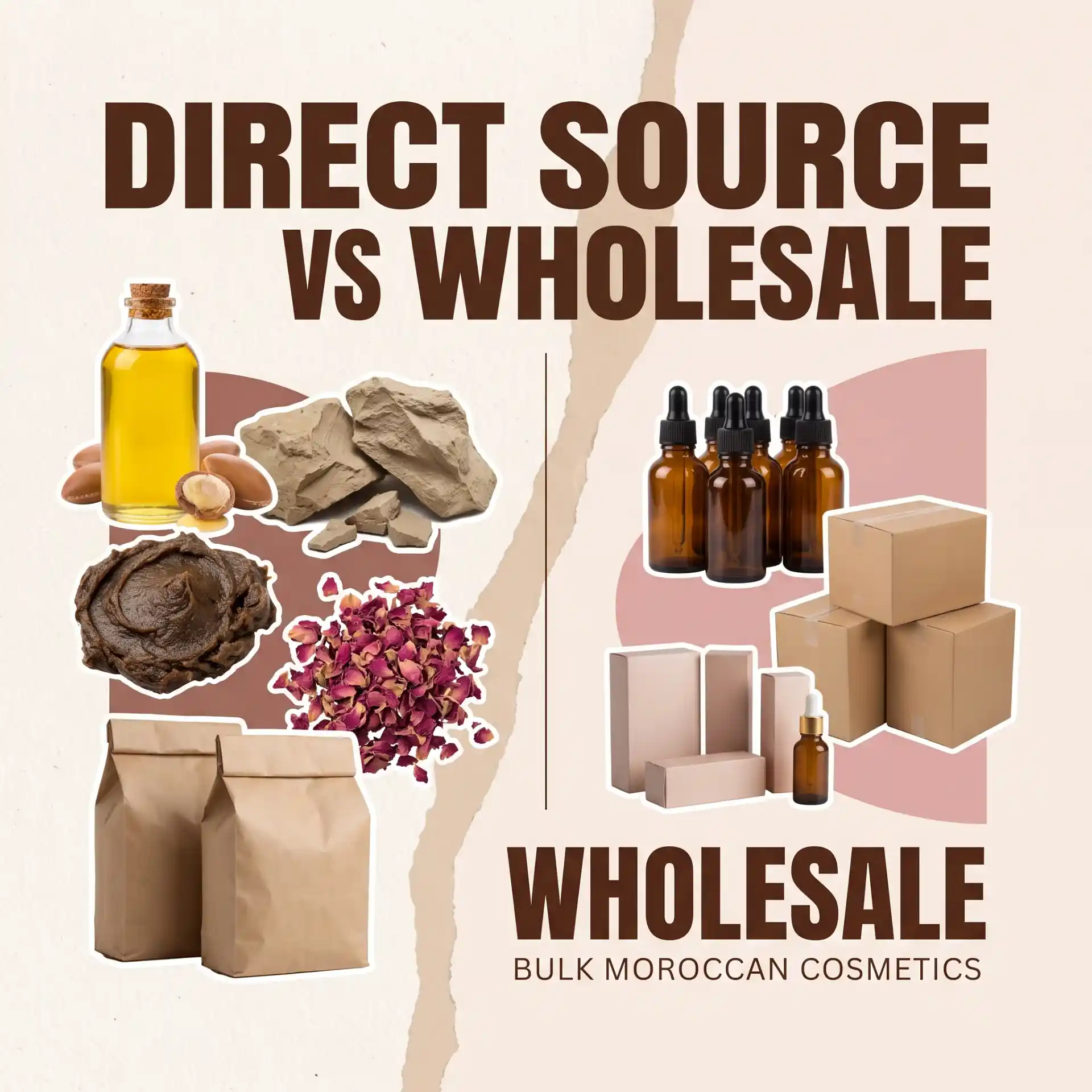
The global demand for botanical cosmetic ingredients has placed Moroccan beauty products at the epicenter of the clean beauty movement. Formulators, indie brand founders, and established personal care corporations routinely seek out raw, high-value Moroccan exports like cold-pressed Argan oil, virgin Prickly Pear seed oil, mineral-rich Rhassoul (Ghassoul) clay, and traditional Beldi black soap. However, securing a reliable, high-purity supply chain from Morocco presents a complex strategic choice: Should you source bulk cosmetics directly from local agricultural cooperatives, or partner with established wholesale middlemen and export aggregators?
While direct sourcing from rural cooperatives promises ethical storytelling and unblended purity, navigating international logistics, batch consistency, and export regulations can present unexpected hurdles. Conversely, commercial middlemen simplify procurement and testing, but may introduce margin markups, reduced supply visibility, or diluted ethical narratives. This guide provides a comprehensive B2B comparative analysis to help purchasing directors and brand managers choose the optimal procurement route for their Moroccan cosmetic sourcing strategy.
Understanding the Moroccan Cosmetics Supply Chain
To effectively navigate wholesale procurement in North Africa, buyers must first understand how raw cosmetic botanicals transition from rural harvests to international manufacturing facilities.
1. Women’s Agricultural Cooperatives (Coopératives Agricoles)
Moroccan cooperatives are socio-economic organizations—predominantly operated by indigenous Amazigh women in regions like Souss-Massa, Ait Baamrane, and the Dadès Valley. These entities handle the manual collection, decortication, and initial cold-pressing of raw botanicals. Cooperatives play a vital role in rural poverty alleviation and environmental conservation, operating under government support frameworks managed by the Ministry of Agriculture.
2. Export Middlemen, Wholesalers, and Aggregators
Middlemen operate between primary producers and foreign buyers. This category spans several business structures:
- Local Brokers (Courtiers): Independent agents who negotiate price agreements between rural producers and local processing facilities.
- Moroccan Export Houses & Formulators: Domestic entities equipped with industrial filtration, automated bottling, in-house quality control testing, and export documentation capabilities.
- International Ingredients Distributors: Importers based in Europe or North America who clear customs, hold safety stock in local warehouses, and redistribute small-to-midsize drum quantities directly to cosmetic laboratories.
Understanding these supply chain tiers is foundational when evaluating how to source authentic Moroccan cosmetic ingredients without compromising on safety, lead times, or pricing stability.
Direct Cooperatives vs. Middlemen: Head-to-Head Comparison
When evaluating supply partners, brand managers must weigh direct costs against operational complexity. Below is a structured comparison of the two sourcing models across key commercial criteria:
| Sourcing Criteria | Direct Women's Cooperative | Wholesale Middleman / Aggregator |
|---|---|---|
| Primary Advantage | Maximum traceability & authentic ethical marketing narrative | Turnkey compliance, consistent specs, & simplified logistics |
| Pricing Structure | Lower unit raw material cost (FOB); higher overhead per shipment | Higher unit material cost; predictable, bundled freight/compliance costs |
| Batch Consistency | Variable; dependent on seasonal harvest & manual extraction methods | Standardized through industrial blending, micro-filtration, and lab oversight |
| Regulatory Dossiers | Basic; often lacks full CoA, MSDS, or CPNP compatibility | Comprehensive (CoA, SDS, IFRA, Allergen reports, ISO 22716 compliance) |
| Minimum Order Quantity (MOQ) | High for direct export viability (e.g., 100L–500L+) | Flexible; ranges from 5L sample drums to multi-pallet shipments |
| Export Documentation | Buyer must handle or assist with customs clearance and phytosanitary filings | Fully managed; Incoterms offered up to DDP (Delivered Duty Paid) |
Deep Dive: Direct Sourcing from Moroccan Cooperatives
The Strategic Benefits
For brands building their identity around corporate social responsibility (CSR) and fair-trade principles, direct cooperative sourcing delivers unmatched authenticity. Working directly with raw material producers unlocks several major advantages:
- Uncompromised Storytelling & ESG Impact: Direct purchasing empowers indigenous women's networks, directing capital into local education, healthcare, and infrastructure. This provides tangible metrics for ESG reporting and sustainability claims. Learn more about sustainable cosmetics sourcing through Moroccan cooperatives.
- Single-Origin Traceability: Buyers can pinpoint the exact region, valley, and harvest window of their botanical oils or clays, minimizing the risk of multi-source blending.
- Competitive First-Cost Rates: Eliminating distributor markups can result in lower raw material prices per liter at origin, provided order volumes justify the export logistics overhead.
The Operational Challenges
Despite the moral and brand benefits, contracting directly with small rural cooperatives carries operational realities that can disrupt supply chains if not managed proactively:
- Regulatory and Quality Gaps: Many small cooperatives lack on-site analytical laboratories. Crucial metrics such as free fatty acid (FFA) levels, peroxide values, and heavy metal testing may not be systematically documented per batch, requiring buyers to fund third-party laboratory verification.
- Bureaucratic & Export Delays: Exporting raw cosmetic ingredients from Morocco requires strict clearance from national food and health safety authorities like ONSSA (Office National de Sécurité Sanitaire des Produits Alimentaires). Cooperatives unaccustomed to international customs regulations may face administrative delays.
- Communication Constraints: Negotiations and technical documentation often require fluency in French or Moroccan Arabic (Darija), alongside an understanding of local business customs.
Deep Dive: Sourcing via Middlemen and Specialized Exporters
The Strategic Benefits
Working with an established B2B aggregator or specialized exporter bridges the gap between rural production and stringent international regulations:
- Guaranteed Technical Compliance: Established export partners supply comprehensive technical dossiers required by regulatory bodies such as the US FDA or the European Chemicals Agency under the EU Cosmetics Regulation (EC) No 1223/2009. Dossiers routinely include batch-specific Certificates of Analysis (CoA), Safety Data Sheets (SDS), and microbiological testing.
- Standardized Quality & Industrial Filtration: Professional exporters process raw oils through multi-stage cold filtration systems, removing sediment, excess moisture, and volatile odor compounds without degrading thermolabile active compounds.
- Operational Efficiency: Exporters handle export licensing, customs brokerage, phytosanitary certifications, and door-to-door freight (CIF/DDP), allowing brand development teams to focus on formulation and marketing.
The Drawbacks
- Cost Markups: Middlemen charge fees to cover quality assurance, warehousing, documentation, and operational margins, resulting in a higher cost per kilogram.
- Risk of Supply Chain Opacity: Without direct supplier audits, brands run the risk of purchasing oil aggregated from multiple unvetted secondary markets, increasing the need for spotting unadulterated oil through laboratory testing.
5-Step Procurement Checklist for Bulk Moroccan Cosmetics
Whether choosing direct cooperative partnerships or managed distributor relationships, procurement teams should execute this 5-step verification process before finalizing supply agreements:
1. Demand Batch-Specific Analytical Dossiers
Never rely on generic specification sheets. Request a Certificate of Analysis (CoA) for the actual lot being purchased, paying close attention to:
- Peroxide Value (PV): Indicates oxidation state; high-quality cosmetic Argan oil should maintain a PV well below 10 mEq O₂/kg at time of dispatch.
- Free Fatty Acid (FFA) Content: Measures oil hydrolysis; lower levels indicate fresh, undamaged seed processing.
- Fatty Acid Profile (Gas Chromatography): Confirms botanical identity and screens for adulteration with cheaper vegetable oils (e.g., sunflower, soybean).
2. Verify Organic & Facility Certifications
Ensure that claimed certifications belong to the manufacturing facility or cooperative directly, rather than an external affiliate. Look for recognized standards such as USDA Organic, ECOCERT, or manufacturing standards aligned with ISO 22716 Good Manufacturing Practices (GMP).
3. Confirm Export Licensing & Legal Compliance
Verify that the supplier holds active export licensing through Morocco's Ministry of Industry and Commerce, as well as ONSSA authorization. Goods shipped without proper export declarations face border seizures or prolonged customs holds.
4. Execute Pre-Shipment Sample Testing
Always order a representative pre-shipment sample (PSS) from the exact batch reserved for your order. Run sensory evaluations (color, clarity, characteristic aroma) alongside independent third-party laboratory verification before approving final balance payments.
5. Clarify Incoterms and Freight Responsibilities
Explicitly define shipping terms in the purchase contract. Sourcing directly from cooperatives often requires purchasing on FOB (Free on Board) terms from Casablanca or Agadir ports, requiring your logistics team to handle marine insurance, ocean/air freight, and import clearance. Middlemen frequently offer CIF (Cost, Insurance, and Freight) or DDP (Delivered Duty Paid) terms, reducing import complexity for the buyer.
The Hybrid Sourcing Model: A Balanced Approach
Many successful natural beauty brands adopt a hybrid sourcing model to balance risk with supply chain integrity. In this framework, brands partner with an ethical exporter or managed network that works directly with accredited women’s cooperatives in Morocco.
Under a hybrid approach:
- Primary harvesting and initial extraction remain at the rural cooperative level, preserving local economic benefits and ethical narratives.
- A professional export partner oversees quality control, secondary micro-filtration, standardized batch packaging, regulatory documentation, and international export management.
This structure allows cosmetic brands to maintain authentic ethical claims while guaranteeing the technical rigor required by corporate compliance departments and commercial contract manufacturers. To explore product formats, custom blending, and private label execution under this structured framework, consult our guide to private label Moroccan skincare sourcing or read our detailed operational overview on how to buy premium organic Argan oil in bulk.
Frequently Asked Questions (FAQ)
Is it cheaper to buy bulk cosmetic ingredients directly from a Moroccan cooperative?
While the initial cost per liter (FOB) from a cooperative is often lower than distributor prices, total landed costs may increase once independent lab testing, freight consolidation, export documentation, and customs clearance overheads are added. Direct sourcing becomes cost-effective primarily at larger volumes (e.g., 500+ liters per shipment).
What regulatory documentation is needed to import cosmetic raw materials from Morocco into the EU or US?
To import raw cosmetic botanicals into the European Union or United States, buyers typically require a Safety Data Sheet (SDS) compliant with GHS standards, a batch-specific Certificate of Analysis (CoA), a Technical Data Sheet (TDS), an IFRA statement (for aromatic distillates/essential oils), an Allergen Declaration, and an ONSSA Phytosanitary/Health Certificate issued at origin.
How can brands verify that bulk Argan or Prickly Pear Seed oil is not diluted?
Purity is confirmed through Gas Chromatography-Mass Spectrometry (GC-MS) analysis, which maps the specific fatty acid and sterol profile of the oil. Purity testing also evaluates iodine values, saponification values, and refractive indexes against international pharmacopeia standards.
What is ONSSA certification, and why is it mandatory for Moroccan cosmetics exports?
ONSSA (Office National de Sécurité Sanitaire des Produits Alimentaires) is Morocco's national sanitary and safety authority. ONSSA certification verifies that agricultural and cosmetic raw material facilities meet strict hygiene, health, and trace-element safety standards required for legal export from Morocco.