How to Spot Fake Argan Oil: Sourcing & Purity Guide
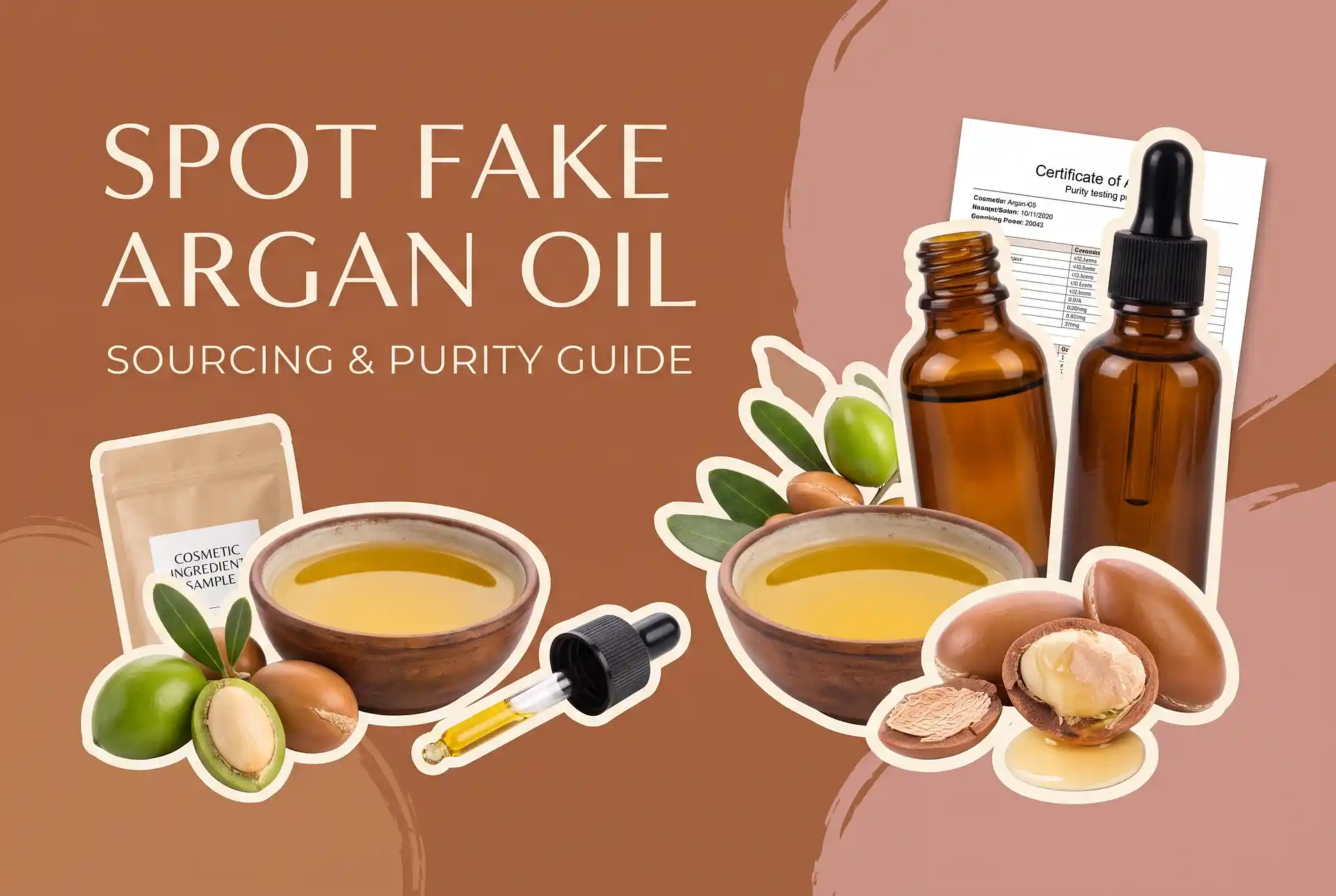
The Growing Challenge of Argan Oil Adulteration
Argan oil, often referred to as "liquid gold," is one of the most revered natural botanical oils in the global cosmetics and culinary industries. Native strictly to the endemic Argania spinosa trees of southwestern Morocco, pure argan oil requires labor-intensive harvesting and extraction processes. Because supply is naturally limited and global demand continues to surge, the commercial incentive to produce counterfeit, diluted, or low-grade argan oil is exceptionally high.
For consumers seeking genuine skin and hair benefits, as well as cosmetic formulators, brand owners, and procurement managers, distinguishing pure cosmetic-grade argan oil from fraudulent or heavily refined substitutes is essential. Adulterated argan oil not only underperforms in topical applications but can also cause adverse skin reactions, clog pores, or destabilize formulation shelf-lives.
This comprehensive guide details the sensory characteristics, practical field tests, professional laboratory testing standards, and supply chain verification practices needed to identify authentic, unadulterated Moroccan argan oil.
Understanding the Types: Culinary vs. Cosmetic Argan Oil
Before testing for purity, it is crucial to recognize that pure argan oil exists in two distinct forms based on production methodology:
| Property | Cosmetic Argan Oil | Culinary Argan Oil |
|---|---|---|
| Seed Preparation | Raw, unroasted argan kernels | Lightly roasted argan kernels |
| Color | Light golden-yellow to straw yellow | Deep amber to golden brown |
| Aroma | Subtle, light nuttiness that fades quickly | Rich, pronounced, nutty, toasted aroma |
| Primary Application | Skincare, haircare, cosmetic formulations | Dipping, culinary finishing, traditional dishes |
Confusing these two types is a common point of misunderstanding. Using culinary argan oil on the skin is not dangerous, but the roasting process reduces certain heat-sensitive antioxidants and produces a strong food-like aroma that is typically undesirable in cosmetic applications. Conversely, cosmetic argan oil should never possess a dark brown hue or a heavily toasted smell.
Sensory and Physical Identification Markers
Evaluating physical and organoleptic properties is the first defense against fraudulent or poor-quality argan oil. Authentic virgin cold-pressed argan oil exhibits specific physical traits:
1. Appearance and Color
Pure cosmetic argan oil displays a clear, pale golden-yellow tone. If the oil is completely clear like water, it has likely undergone severe bleaching, deodorization, or heavy solvent refining. Conversely, if it is dark brown or reddish, it has either been made from roasted seeds (culinary grade), subjected to excessive heat during extraction, or contaminated.
2. Aroma Profile
Smell is one of the most reliable indicators of quality:
- Authentic Cosmetic Grade: Has a faint, raw, nutty, or slightly earthy scent upon application. Crucially, this natural aroma should dissipate within 3–5 minutes after application as the skin absorbs the oil.
- Odorless: Pure cold-pressed argan oil is never naturally odorless. Completely odorless oil indicates industrial deodorization or dilution with mineral oil or odorless carrier oils.
- Foul or Rancid: A sharp, sour, or unpleasant smell indicates lipid oxidation (rancidity), poor kernel storage, or goat-ingested seeds that were gathered improperly.
- Artificially Fragranced: Strong floral or synthetic perfume masks degraded or heavily diluted base oils.
3. Texture and Skin Absorption
Pure argan oil feels smooth, silky, and rich, yet light. When applied to the skin:
- It penetrates rapidly without leaving an excessively sticky, greasy, or heavy film.
- It provides lasting hydration without clogging pores.
- If the oil sits on top of the skin for hours like heavy mineral oil, or feels sticky like synthetic silicone additives, it is highly likely adulterated.
Using unadulterated argan oil is particularly effective in targeted skincare routines, such as post-exfoliation treatments or when learning how to treat keratosis pilaris naturally with Moroccan exfoliation, where pure barrier-repairing lipids are needed to soothe raw skin without causing follicular blockage.
Practical At-Home and Field Purity Tests
While definitive confirmation requires laboratory analysis, several preliminary tests can help evaluate oil integrity in a non-laboratory setting.
The Refrigerator / Cold Test
Pure virgin cold-pressed argan oil contains a balanced ratio of monounsaturated fatty acids (like oleic acid) and saturated fatty acids (like palmitic and stearic acids). When placed in a refrigerator at around 4°C (39°F) for 12 to 24 hours:
- Pure Argan Oil: Will become thick, viscous, cloudy, or partially solidify due to the freezing points of its naturally occurring saturated fatty acids.
- Adulterated Oil: If the oil remains entirely liquid, thin, and clear after extended refrigeration, it likely contains high proportions of cheap liquid vegetable oils (like high-oleic sunflower or soybean oil) or liquid silicone derivatives.
Note: The cold test is an indicator, not a final scientific proof, as some blending oils may also cloud under cold conditions.
Sediment Inspection
Unrefined, cold-pressed argan oil often leaves a minute amount of natural sediment at the bottom of the bottle over time. This micro-sediment consists of natural plant sterols and protein traces that settle out of suspension. The presence of a tiny, fine sediment layer in an unfiltered batch is often a sign of traditional cold-pressing, whereas synthetic or heavily processed oils remain unnaturally uniform.
Paper Blotter Absorption Test
Place a single drop of the oil onto plain brown paper or a cosmetic blotting sheet:
- Pure argan oil spreads evenly, absorbs gradually, and leaves a smooth ring that gradually dries down without a thick, greasy, non-drying residue.
- Oils mixed with heavy mineral oil leave an indelible, sticky, non-evaporating stain that remains greasy to the touch indefinitely.
Chemical Profiling: Laboratory Testing Standards
For B2B buyers, cosmetic formulators, and brand owners evaluating commercial supply, relying solely on sensory checks is insufficient. High-purity sourcing demands rigorous analytical laboratory verification using Gas Chromatography (GC) and High-Performance Liquid Chromatography (HPLC).
1. Fatty Acid Composition (FAC)
Authentic Argania spinosa kernel oil possesses a specific, narrow fatty acid spectrum. International standards set by official authorities establish the following percentage ranges for genuine argan oil:
| Fatty Acid | Chemical Name | Authentic Specification Range (%) |
|---|---|---|
| Oleic Acid | C18:1 | 43.0% – 49.0% |
| Linoleic Acid | C18:2 | 29.0% – 36.0% |
| Palmitic Acid | C16:0 | 11.5% – 15.0% |
| Stearic Acid | C18:0 | 4.3% – 7.5% |
| Linolenic Acid | C18:3 | < 0.2% |
A linolenic acid (C18:3) content exceeding 0.3% is an immediate red flag, indicating contamination or dilution with seed oils rich in linolenic acid, such as rapeseed or soybean oil.
2. Sterol Profile Analysis
Sterol analysis is the definitive fingerprint for botanical oil verification. Unlike many common vegetable oils, argan oil naturally lacks brassicasterol and contains high levels of specific sterols:
- Schottenol: Typically 44% – 49% of total sterols.
- Spinasterol: Typically 34% – 44% of total sterols.
- Campesterol: Extremely low (< 0.4%).
If testing reveals elevated levels of campesterol, sitosterol, or any trace of brassicasterol, the sample is undeniably adulterated with oils such as canola, sunflower, or soy.
3. Tocopherol (Vitamin E) Content
Pure argan oil is rich in natural tocopherols, primarily gamma-tocopherol (representing roughly 80–90% of its total vitamin E content). Total tocopherol levels should fall between 600 mg/kg and 900 mg/kg. Unnaturally low tocopherol levels indicate old, oxidized, or solvent-extracted oils.
When comparing lipid profiles in advanced cosmetic formulations, brand owners often evaluate argan oil alongside other premium Moroccan botanicals. For instance, analyzing prickly pear seed oil vs argan oil for anti-aging applications reveals distinct tocopherol and fatty acid ratios, helping formulators select the optimal active oil for their target demographic.
Packaging and Storage Requirements
Packaging plays a fundamental role in maintaining oil purity and preventing premature degradation:
- Glass Containers: Pure argan oil should always be packaged in dark amber, cobalt blue, or opaque glass bottles. UV light breaks down double bonds in fatty acids, accelerating oxidation and producing free radicals.
- Plastic Risk: High-purity unrefined oils can leach phthalates and chemical compounds from low-grade clear plastic bottles over time. Clear plastic packaging is a sign of mass-market, low-quality production.
- Dosing Pumps vs. Open Tops: Droppers or pump dispensers minimize exposure to atmospheric oxygen, prolonging shelf life.
B2B Sourcing and Supply Chain Verification Best Practices
For beauty entrepreneurs and procurement specialists launching products—whether evaluating white label vs private label cosmetics for a Moroccan beauty brand or ordering raw bulk ingredients—vetting suppliers requires systematic due diligence.
Key Documentation to Request from Suppliers
- Certificate of Analysis (CoA): Must be batch-specific and include full fatty acid distribution, acid value (< 2.0 mg KOH/g for virgin oil), and peroxide value (< 15 meq O2/kg).
- MSDS / SDS (Material Safety Data Sheet): Provides essential safety, storage, and handling guidelines.
- Organic Certification: Verification from recognized accreditation bodies (such as USDA Organic, ECOCERT, or EU Organic).
- Geographical Origin Verification: Confirmation that the kernels were harvested and cold-pressed within the designated argan biome of southwestern Morocco.
Strict quality assurance standards apply to other classic Moroccan cosmetic ingredients as well. Sourcing principles for argan oil align closely with those required when sourcing authentic Moroccan Nila powder vs Indigofera substitutes, or when procuring pure raw materials for traditional color cosmetic formulations like a DIY Aker Fassi tint blush.
Summary Checklist for Spotting Fake Argan Oil
- Check the ingredient list: The label must read 100% Argania Spinosa Kernel Oil with no added fragrances, preservatives, or mineral oils.
- Assess the price point: True cold-pressed virgin argan oil requires roughly 30 kg of fruit and hours of hand labor per liter. Extremely low prices indicate dilution or chemical extraction.
- Observe the color and scent: A soft straw-gold hue with a mild nutty scent that fades quickly on the skin. Avoid dark brown, water-clear, or strongly fragranced oils.
- Evaluate skin feel: Fast-absorbing, non-greasy, non-sticky finish.
- Require full lab documentation: Demand batch-specific CoAs confirming sterol and fatty acid profiles for bulk or wholesale sourcing.
Frequently Asked Questions
What is the most common adulterant found in fake argan oil?
The most common adulterants are cheap, refined vegetable oils such as sunflower, soybean, canola, and palm oil, as well as odorless mineral oil and synthetic silicones (such as cyclomethicone or dimethicone). These additives reduce production costs while mimicking a slick texture.
Does pure argan oil freeze or solidify in the cold?
Yes. Because pure argan oil contains around 15–20% saturated fatty acids (palmitic and stearic acids), it naturally becomes cloudy, thickens, or partially solidifies when exposed to refrigerator temperatures (around 4°C / 39°F) for several hours.
Why does some argan oil have almost no smell while other batches smell stronger?
Natural variation occurs based on kernel harvest conditions, pressing temperatures, and filtration levels. However, cosmetic argan oil should always possess a subtle, faint nutty scent. If an oil is entirely odorless, it has likely been industrially deodorized using high heat or steam, which degrades heat-sensitive antioxidants and essential fatty acids.
How long does pure cold-pressed argan oil remain stable?
When stored in dark glass containers away from direct sunlight and heat sources, high-quality cold-pressed virgin argan oil has a typical shelf life of 18 to 24 months. High naturally occurring levels of gamma-tocopherol (Vitamin E) act as natural antioxidants that protect the oil against rapid oxidation.