White Label vs Private Label Cosmetics: Moroccan Beauty
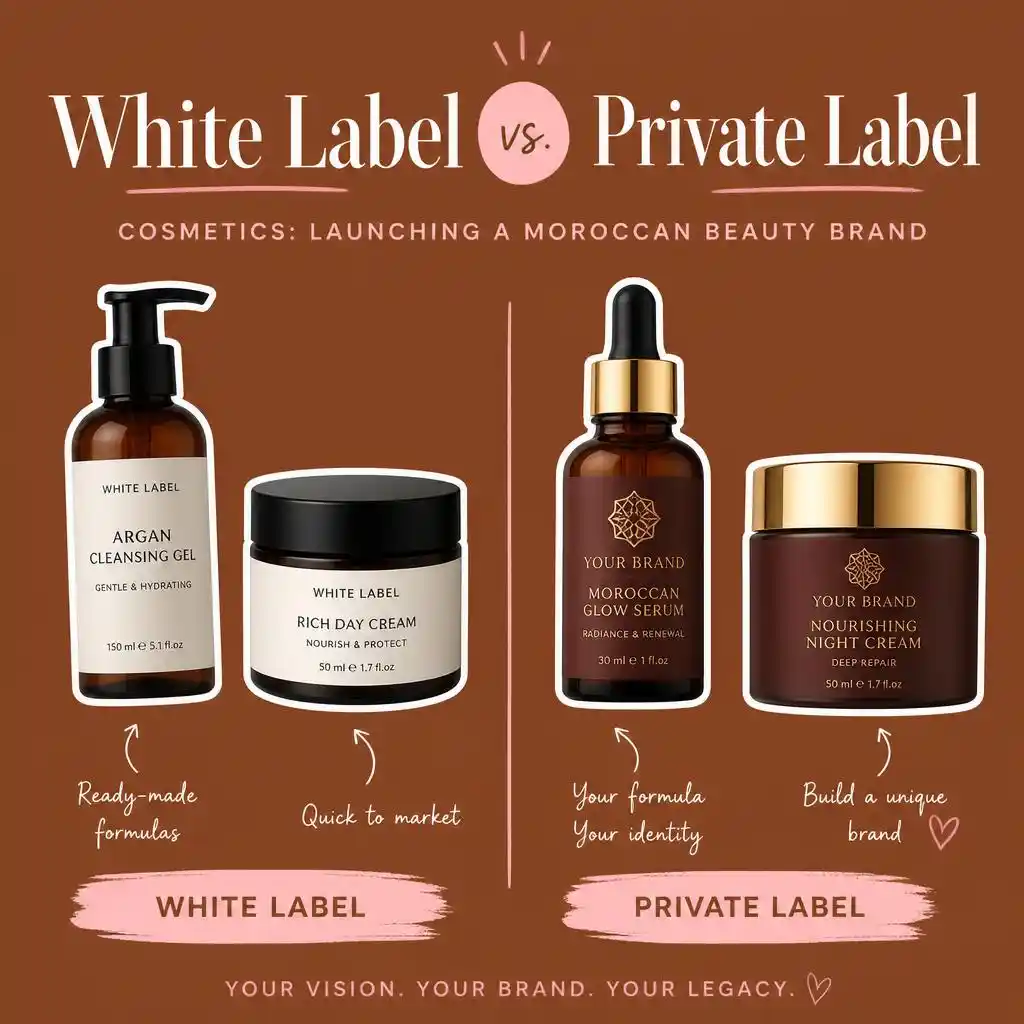
The global demand for clean, botanical, and heritage-driven skincare has placed Moroccan beauty products at the forefront of the international cosmetics market. From pure cold-pressed argan oil and anti-aging prickly pear seed oil to clarifying rhassoul clay and traditional black soap, Moroccan ingredients offer a rich narrative alongside proven efficacy. However, for entrepreneurs and beauty brand founders, turning an idea for a Moroccan skincare line into a market-ready brand requires a critical strategic decision: choosing between white label and private label manufacturing.
While both business models allow you to launch a cosmetic brand without building your own manufacturing plant from scratch, they differ significantly in terms of customization, upfront investment, minimum order quantities (MOQs), intellectual property, and speed to market. Understanding these nuances is essential for positioning your brand effectively in today’s competitive skincare landscape.
Understanding White Label Cosmetics
White label cosmetics are pre-formulated, generic products produced by a manufacturer and sold to multiple retailers. The buyer simply applies their own branding, logo, and secondary packaging to the existing product.
In the context of Moroccan beauty, a white label approach usually involves purchasing standard, ready-to-ship products—such as 100% pure organic argan oil or pre-mixed rhassoul face masks—and packaging them under your brand name.
Advantages of White Labeling
- Speed to Market: Since the formulation, stability testing, and safety evaluations are already complete, you can launch your brand in weeks rather than months.
- Lower Initial Capital: White label manufacturers often offer significantly lower Minimum Order Quantities (MOQs), reducing financial risk for startup founders.
- Turnkey Regulatory Compliance: Trusted white label products generally come with existing safety assessments, technical data sheets (TDS), and Certificates of Analysis (CoA).
Disadvantages of White Labeling
- Limited Product Differentiation: Multiple brands may sell the exact same formula, differing only in bottle design and marketing storyline.
- No Ownership of Formula: You do not own the formulation rights, making it difficult to adjust ingredients, textures, or scents as your customer feedback evolves.
Understanding Private Label Cosmetics
Private label cosmetics offer a higher degree of customization. In a private label model, a contract manufacturer creates a custom or semi-custom formulation exclusively for your brand. You have control over ingredient selection, active concentrations, scent profiles, texture, and functional claims.
For a Moroccan beauty brand, private labeling allows you to combine traditional Moroccan botanical extracts with modern dermatological actives. For example, instead of selling pure argan oil, you might formulate a proprietary barrier-repair serum combining organic Moroccan argan oil with hyaluronic acid and niacinamide.
Advantages of Private Labeling
- Unique Brand Equity: Your products feature proprietary formulations that competitors cannot easily duplicate.
- Tailored Ingredient Profiling: You can highlight unique synergies, such as comparing prickly pear seed oil vs argan oil for anti-aging and combining both in ideal ratios to deliver superior results.
- Greater Scalability and Profit Margins: As order volumes scale, unit production costs drop, leading to healthier gross margins over time.
Disadvantages of Private Labeling
- Higher Upfront Costs: Custom formulation, research and development (R&D), microbial challenge testing, and regulatory documentation require higher initial capital investment.
- Longer Lead Times: Developing, testing, and refining custom formulas can take anywhere from 4 to 12 months before commercial production begins.
White Label vs. Private Label: Side-by-Side Comparison
To help guide your launch strategy, the table below outlines the core differences between white label and private label manufacturing models for cosmetic products:
| Feature | White Label Cosmetics | Private Label Cosmetics |
|---|---|---|
| Formulation Control | Pre-formulated; zero customization permitted. | Fully customizable or semi-custom formulations. |
| Minimum Order Quantity (MOQ) | Low (often 50 – 500 units). | Moderate to High (typically 1,000 – 5,000+ units per SKU). |
| Development Time | Fast (2 to 6 weeks). | Lengthy (3 to 12 months for R&D & stability testing). |
| Exclusivity | Non-exclusive; formula is available to other brands. | Exclusive; proprietary formula unique to your brand. |
| Upfront R&D Costs | Minimal or none. | Requires investment in formulation and compliance testing. |
| Ideal For | Startup founders testing market demand quickly. | Established brands seeking unique product positioning. |
Strategic Product Opportunities in Moroccan Beauty
Whether you choose white label or private label manufacturing, success relies on leveraging authentic, high-value Moroccan ingredients that resonate with global consumers. Here are key product categories to consider for your brand lineup:
1. Botanical Oils (Argan & Prickly Pear Seed)
Cold-pressed certified organic argan oil and prickly pear seed oil remain cornerstones of Moroccan skincare. Because these pure oils require no complex compounding, they are ideal candidates for high-margin white-label launches. However, private labeling opens doors to multi-correctional facial oils and light body serums tailored for specific skin concerns.
2. Clarifying Clays & Exfoliants
Moroccan Rhassoul clay (Ghassoul) offers natural cleansing and detoxifying properties. A basic white label offering might consist of pure raw rhassoul powder. Conversely, a private label development could transform raw clay into a ready-to-use, hydrated facial mask blended with botanical waters and soothing botanicals. For consumer education on clay formulations, you can refer to our guide on how to make a DIY rhassoul clay face mask.
3. Traditional Body Care Rituals
Moroccan black soap (Sabon Beldi) paired with a Kessa exfoliating glove offers a distinct spa ritual experience. This combination is highly effective for smoothing skin texture and addressing conditions like rough skin patches. Learn more about traditional physical exfoliation in our detailed post on how to treat keratosis pilaris naturally with Moroccan exfoliation.
4. Cultural Beauty Accents & Targeted Treatments
Authentic regional ingredients can give your brand a distinct storytelling edge. Traditional botanical colorants like Aker Fassi (poppy petal and pomegranate rind powder) can inspire innovative lip and cheek products. Read more about its traditional uses in our Aker Fassi tint and blush guide. Similarly, natural brightening body lines targeting hyperpigmentation are growing in popularity—explore formulating approaches in our article on how to lighten dark knees and elbows naturally.
Key Sourcing and Regulatory Considerations
When launching a cosmetic brand centered on Moroccan ingredients, ensuring product safety, authenticity, and legal compliance is paramount. Regardless of whether you opt for white label or private label manufacturing, verify that your supply chain adheres to international cosmetic regulations:
- International Cosmetic Compliance: Ensure your manufacturing partner adheres to ISO 22716 Good Manufacturing Practices (GMP). If selling in the European Union or the United Kingdom, products must comply with EU Regulation (EC) No 1223/2009 and possess a completed Cosmetic Product Safety Report (CPSR). In the US, compliance with the FDA’s Modernization of Cosmetics Regulation Act (MoCRA) is required.
- Raw Material Traceability: Insist on receiving a Certificate of Analysis (CoA), Material Safety Data Sheet (MSDS), and organic certification (such as ECOCERT or USDA Organic) for all raw oils and extracts sourced from Morocco.
- Local Export & Quality Approvals: Authentic Moroccan botanical products produced for export should meet local standards set by authorities such as ONSSA (National Office for Food Safety) to guarantee purity and batch-to-batch consistency.
How to Decide Which Path Is Right for Your Brand
Choosing between white label and private label cosmetics comes down to three strategic variables: budget, timeline, and long-term brand vision.
Choose White Label if:
- You are testing a new e-commerce storefront or beauty niche with minimal financial risk.
- You want to launch within 30 to 60 days to capitalize on current market trends.
- Your marketing strategy relies on brand storytelling, design, and influencer marketing rather than proprietary formulation technology.
Choose Private Label if:
- You have working capital secured for custom formulation testing, stability studies, and larger opening inventory runs.
- You plan to sell through retail stockists, boutiques, or high-end spas that demand exclusive formulas.
- You aim to build enterprise value in a proprietary product line with unique clinical performance or botanical active combinations.
Frequently Asked Questions
Can I transition from white label to private label as my brand grows?
Yes. Many successful beauty founders start with a white label range to validate customer demand and build brand equity. Once cash flow is established, they re-invest profits into custom private label formulations to differentiate their brand and improve profit margins.
What is the typical minimum order quantity (MOQ) for launching a skincare line?
White label cosmetics often feature MOQs as low as 50 to 500 units per item. Private label formulations generally require higher production runs, typically starting at 1,000 to 5,000 units per SKU depending on container complexity and specialized raw materials.
Are Moroccan ingredients suitable for sensitive skin formulations?
Many traditional Moroccan ingredients—such as pure cold-pressed argan oil and mineral-rich rhassoul clay—are well-tolerated by sensitive skin types due to their natural soothing and non-comedogenic properties. However, dermatological patch testing and professional safety evaluations are essential prior to placing any cosmetic product on the market.
Conclusion
Launching a successful Moroccan beauty brand requires balancing commercial feasibility with product excellence. A white label approach provides a fast, accessible entry point for testing market demand, while private label manufacturing delivers the exclusivity, control, and formula ownership required for long-term retail scaling. By aligning your business model with your capital structure and product roadmap, you can build a compelling beauty brand rooted in authentic Moroccan heritage.