INCI names for traditional Moroccan cosmetic ingredients
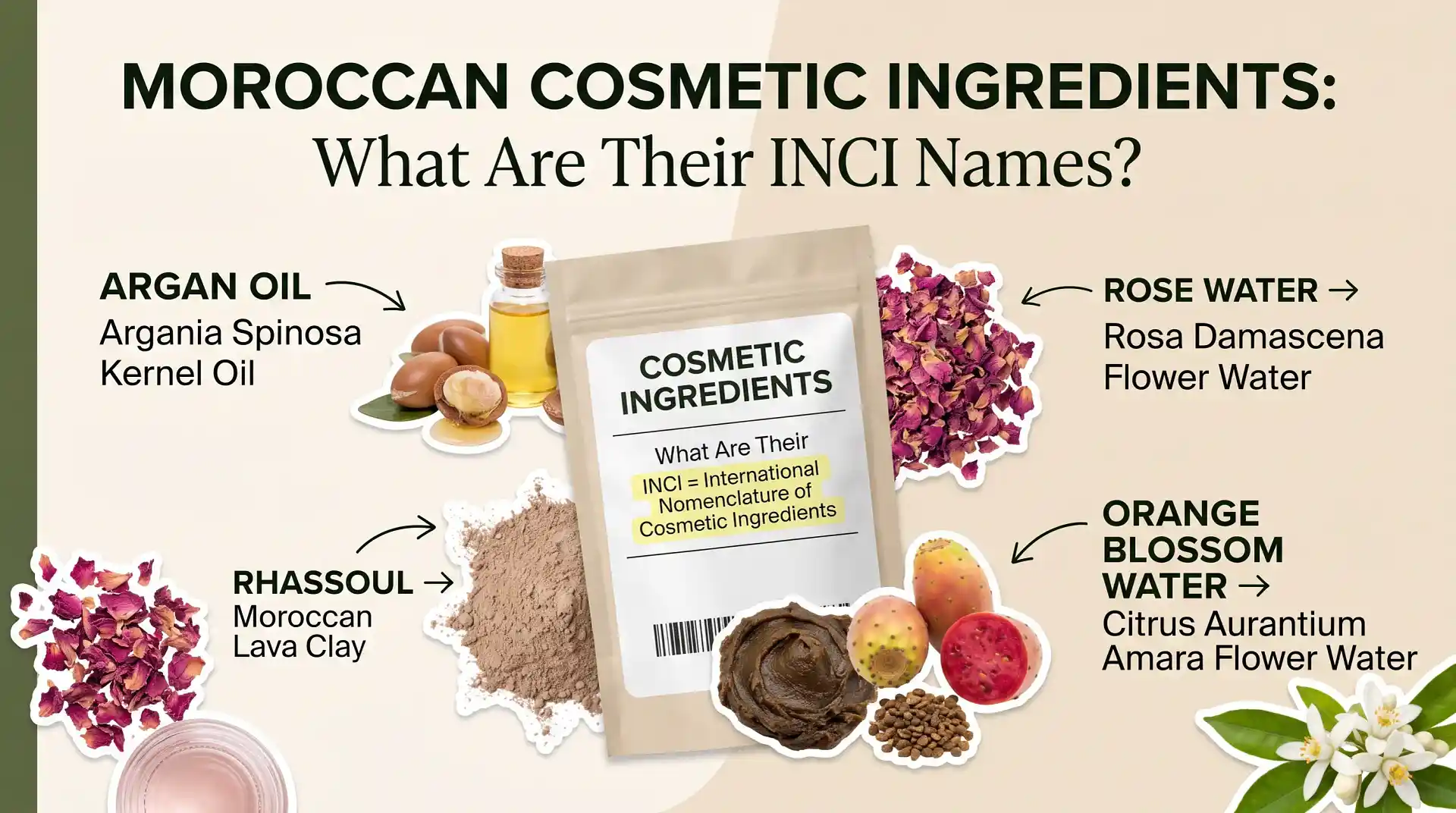
Understanding INCI Nomenclature for Moroccan Heritage Ingredients
For cosmetic formulators, product developers, and regulatory compliance specialists, transitioning traditional beauty rituals into commercially viable, globally compliant products requires precise ingredient identification. The International Nomenclature Cosmetic Ingredient (INCI) system, governed by the Personal Care Products Council (PCPC) and recognized by global regulatory bodies like the European Commission via the EU CosIng Database and the U.S. Food and Drug Administration (FDA), provides a standardized language for cosmetic labeling.
Traditional Moroccan beauty ingredients—historically known by regional Arabic or Amazigh terms such as Ghassoul, Beldi, or Aker Fassi—must be correctly translated into standardized INCI nomenclature for retail packaging, safety assessments, and customs clearances. Mislabeling a botanical or mineral raw material can lead to regulatory rejection, inaccurate safety reporting, or consumer distrust.
This comprehensive technical reference guide details the standard INCI names, CAS numbers, chemical designations, and formulation functions for the most prominent traditional Moroccan cosmetic raw materials.
Master Reference: Moroccan Cosmetic Ingredients & INCI Standard
| Traditional / Common Name | Standard INCI Designation | CAS Number | Primary Cosmetic Function |
|---|---|---|---|
| Argan Oil | Argania Spinosa Kernel Oil | 223747-87-3 | Skin conditioning, emollient, hair conditioning |
| Prickly Pear Seed Oil | Opuntia Ficus-Indica Seed Oil | 90082-21-6 / 223748-73-0 | Skin conditioning, antioxidant, anti-aging emollient |
| Rhassoul / Ghassoul Clay | Moroccan Lava Clay | 12199-37-0 / 84082-62-2 | Absorbent, bulking, skin conditioning, cleansing |
| Moroccan Black Soap (Beldi) | Potassium Olivate (and) Aqua (and) Olea Europaea Fruit Oil | 68154-77-8 (Potassium Olivate) | Surfactant, cleansing agent, skin conditioning |
| Damask Rose Water | Rosa Damascena Flower Water | 90106-38-0 | Astringent, fragrance, skin conditioning, soothing |
| Orange Blossom Water | Citrus Aurantium Amara Flower Water | 72968-50-4 / 8016-38-4 | Toning, skin conditioning, delicate fragrance |
| Aker Fassi Powder | Papaver Rhoeas Petal Powder (and) Punica Granatum Peel Extract | 90082-36-3 / 84961-57-9 | Colorant, skin conditioning, antioxidant |
| Blue Nila Powder | Indigofera Tinctoria Leaf Powder (or mineral composition) | 84775-63-3 | Skin conditioning, colorant, brightening agent |
| Moroccan Red Clay | Illite (or Kaolin / Clay) | 12173-60-3 / 1332-58-7 | Absorbent, viscosity controlling, cleansing |
| Henna Powder | Lawsonia Inermis Leaf Powder | 84988-66-4 | Hair coloring, hair conditioning, skin conditioning |
Detailed INCI Breakdown by Category
1. Heritage Botanical Oils & Plant Lipids
Argan Oil
- INCI Name: Argania Spinosa Kernel Oil
- EINECS/ELINCS No.: 273-746-0
- Botanical Family: Sapotaceae
- Formulation Notes: Standard cosmetic-grade cold-pressed argan oil must be listed as
Argania Spinosa Kernel Oil. If using hydrogenated or modified forms, separate INCI entries apply (e.g., Hydrogenated Argania Spinosa Kernel Oil or Argania Spinosa Kernel Extract). When reviewing ingredient purity for market readiness, review the specific technical criteria outlined in our guide on cosmetic grade argan oil cold pressed specifications.
Prickly Pear Seed Oil (Barbary Fig Seed Oil)
- INCI Name: Opuntia Ficus-Indica Seed Oil
- EINECS/ELINCS No.: 290-109-1
- Botanical Family: Cactaceae
- Formulation Notes: Ensure the ingredient is derived specifically from the cold-pressed seeds and not the pericarp fruit tissue. Fruit extract should be listed as Opuntia Ficus-Indica Fruit Extract, which carries entirely different lipid profile characteristics and performance metrics. To understand how these lipids compare performance-wise in anti-aging formulas, consult our analysis on prickly pear seed oil vs argan oil.
2. Moroccan Mineral Clays
Rhassoul Clay (Ghassoul)
- INCI Name: Moroccan Lava Clay
- EINECS/ELINCS No.: 281-982-8
- Mineral Type: Smectite clay, rich in magnesium silica and stevensite.
- Formulation Notes: The official INCI moniker recognized globally for traditional Atlas Mountain clay is
Moroccan Lava Clay. Avoid labeling this simply as "Kaolin" or "Bentonite," as those represent distinct mineral structures classified differently under the chemical inventory databases administered by bodies like ECHA (European Chemicals Agency).
Moroccan Red Clay
- INCI Name: Illite (or Clay / Kaolin)
- EINECS/ELINCS No.: 310-127-6
- Formulation Notes: Depending on the deposit composition from regions such as the High Atlas, natural red clays are composed primarily of illite silicate structures. Formulators should confirm particle size and elemental composition via X-ray diffraction (XRD) testing to select the exact INCI designation required for their target regulatory market.
3. Traditional Saponified Products: Moroccan Black Soap
Beldi Soap (Moroccan Black Soap)
- Standard INCI Composition: Potassium Olivate, Aqua, Olea Europaea Fruit Oil, Glycerin
- Additional Botanical Additives: Eucalyptus Globulus Leaf Oil (if scented with eucalyptus).
- Formulation Notes: Traditional Moroccan Black Soap is not an extracted raw plant matter, but a saponified paste created by reacting olive oil (and often olive pomace pulp) with potassium hydroxide. Because the soap retains unsaponified olive lipids and natural glycerin, the precise regulatory disclosure on product packaging typically requires listing the saponified salt (
Potassium Olivate), vehicle (Aqua), remaining botanical lipids (Olea Europaea Fruit Oil), andGlycerin.
4. Hydrosols & Floral Waters
Damask Rose Water
- INCI Name: Rosa Damascena Flower Water
- EINECS/ELINCS No.: 290-260-3
- Formulation Notes: Distinguish between true steam-distilled floral hydrosols (
Rosa Damascena Flower Water) and reconstituted aqueous solutions containing essential oils or synthetic fragrances mixed with solubilizers (which must disclose all individual surfactant solubilizers and fragrance allergens).
Orange Blossom Water (Neroli Hydrosol)
- INCI Name: Citrus Aurantium Amara Flower Water
- EINECS/ELINCS No.: 277-143-2
- Formulation Notes: Derived from the steam distillation of bitter orange blossoms harvested primarily in North African regions. Ensure standard documentation explicitly notes Amara (bitter orange) rather than Citrus Aurantium Dulcis (sweet orange) to align with international regulatory nomenclature.
5. Heritage Pigments & Botanical Powders
Aker Fassi (Moroccan Poppy & Pomegranate Powder)
- INCI Name: Papaver Rhoeas Petal Powder (and) Punica Granatum Peel Extract
- Formulation Notes: Authentic traditional Aker Fassi is prepared by drying corn poppy petals alongside pomegranate rind over terracotta tiles. When formulating cosmetic tints, blushes, or lip treatments, both botanical components must be individually listed under their accurate INCI designations. For deeper details on traditional manufacturing processes, read our full breakdown on how Aker Fassi is made.
Blue Nila Powder
- Botanical INCI Name: Indigofera Tinctoria Leaf Powder
- Color Index Alternative (if mineral-based mix): CI 75780 or custom botanical blend
- Formulation Notes: "Nila" has historically described both botanical indigo preparations and specific mineral pigment preparations used in regional beauty rituals. Formulators must verify whether their raw batch consists of powdered Indigofera Tinctoria leaves or processed mineral preparations to determine whether to list botanical INCI names or standard Color Index (CI) numbers. For a comprehensive comparison of botanical and mineral varieties, refer to our article on Blue Nila powder vs Indigofera.
Key Regulatory Considerations for Formulators & Brand Owners
When launching commercial cosmetics containing traditional Moroccan ingredients, precise labeling is only the first step. Regulatory compliance across major international markets (US, EU, UK, Canada, and East Asia) demands rigorous technical documentation.
Regulatory Best Practice: Never rely on common regional names on front-of-pack copy without verifying the corresponding CAS number and technical botanical identification on the ingredient Certificate of Analysis (CoA).
Common Labeling Errors to Avoid
- Using Vernacular Language on Ingredient Statements: Phrases such as "Ghassoul Clay," "Beldi Soap," or "Argan Oil" cannot replace official INCI names on required regulatory panels. They may appear in marketing copy, but the ingredient declaration must read
Moroccan Lava ClayorArgania Spinosa Kernel Oil. - Omission of Saponification Details: Listing "Moroccan Black Soap" as a singular ingredient on an INCI declaration is compliant in zero recognized jurisdictions. It must be broken down into its constituent soap base (e.g.,
Potassium Olivate,Aqua,Glycerin). - Confusing Plant Part Identifiers: Argan kernel oil (
Argania Spinosa Kernel Oil) carries distinct toxicological and chemical profiling compared to leaf extract (Argania Spinosa Leaf Extract). Ensure plant parts are accurately recorded. - Unverified Pigment Sources: Traditional botanical pigments like Aker Fassi or Blue Nila must be evaluated for heavy metal residues, microbiological counts, and local color additive compliance (especially under FDA regulations for lip and eye area applications).
- Failure to Disclose Preserving Systems in Hydrosols: Unpreserved floral waters shipped internationally frequently require microbial preservation. Any added preservative (e.g.,
Sodium Benzoate,Potassium Sorbate, orBenzyl Alcohol) must be declared in the final INCI listing.
To ensure full regulatory compliance, traceability, and batch-to-batch consistency when developing clean beauty lines, review our industry guidance on how to source authentic Moroccan cosmetic ingredients.
Frequently Asked Questions
What is the official INCI name for Rhassoul clay?
The official international INCI name for authentic Rhassoul (or Ghassoul) clay is Moroccan Lava Clay. It is registered under CAS numbers 12199-37-0 and 84082-62-2.
How should Moroccan Black Soap (Beldi) be listed on an ingredient panel?
Because traditional Beldi soap is created through the saponification of olive oil with potassium hydroxide, it cannot be listed as a single ingredient. The compliant INCI listing is generally: Potassium Olivate, Aqua, Olea Europaea Fruit Oil, Glycerin (plus any added essential oils like Eucalyptus Globulus Leaf Oil).
What is the INCI name for Prickly Pear Seed Oil?
The correct INCI name for cold-pressed prickly pear seed oil is Opuntia Ficus-Indica Seed Oil. Ensure it is differentiated from fruit extract, which is designated as Opuntia Ficus-Indica Fruit Extract.
How do I list traditional Aker Fassi on a product label?
Authentic traditional Aker Fassi consists of corn poppy petals and pomegranate peel. On an official cosmetic ingredient declaration, it should be listed by its technical components: Papaver Rhoeas Petal Powder and Punica Granatum Peel Extract.