How Aker Fassi Is Truly Made: From Sun-Dried Poppy Petals to Terracotta Vessels
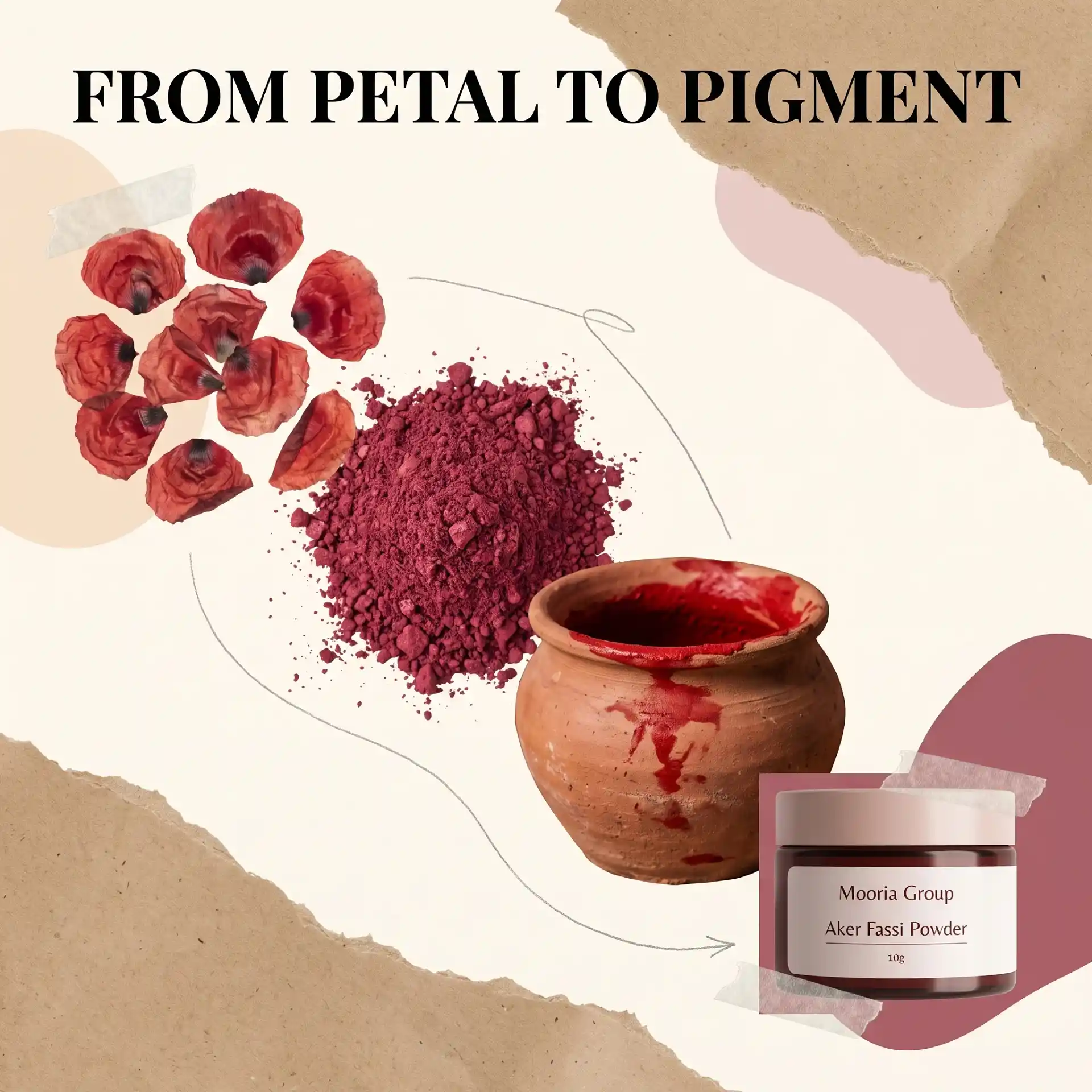
Long before tinted lip and cheek products lined pharmacy shelves, women in Fes were already perfecting a natural stain made from little more than poppy petals, water, and patience. Aker Fassi — literally "the root of Fes" in common usage, though it contains no root at all — is one of Morocco's oldest beauty traditions, and one of the least understood outside the country.
Most descriptions online reduce it to a single line: "a natural red tint made from poppy flowers." The real process is more deliberate than that, involving specific harvesting windows, a slow fermentation stage, and a very particular vessel that traditional makers insist cannot be substituted. Here is how Aker Fassi is actually made, step by step.
What Is Aker Fassi?
Aker Fassi is a traditional Moroccan pigment paste used to tint the lips and cheeks, native to the city of Fes. Unlike modern lip stains built on synthetic dyes, its color comes entirely from the natural pigments of red poppy petals, developed through drying, soaking, and controlled fermentation rather than chemical extraction.
Its defining trait is a soft, blotted, second-skin stain rather than a solid, opaque color — a look that has recently resurfaced in Western "your lips but better" tinting trends, even though Fassi women have relied on it for generations.
Step 1: Harvesting and Sun-Drying the Poppy Petals
The process begins with wild red poppy flowers, traditionally hand-picked during their short early-spring bloom when pigment concentration in the petals is at its peak. Timing matters here: petals harvested too early or too late produce a weaker, less stable color.
Once picked, the petals are spread thin and left to sun-dry over several days. This step does two things at once:
- Removes moisture that would otherwise cause mold during the fermentation stage
- Concentrates the natural anthocyanin pigments responsible for the deep red-pink color
The petals are turned periodically to dry evenly and are never dried in direct, harsh midday sun for too long, as this can degrade the pigment rather than preserve it.
Step 2: The Terracotta Fermentation Process
This is the step most modern reproductions skip entirely, and it's also the one traditional makers consider non-negotiable. The dried petals are placed in an unglazed terracotta vessel with water and left to ferment slowly, sometimes over several weeks. If you want to see this process applied on a smaller scale at home, our DIY Aker Fassi tint and blush guide using Moroccan terracotta walks through a simplified version of this exact method.
During fermentation, the porous clay interacts with the petal liquid in a way glass, plastic, or metal cannot replicate. The vessel slowly draws out and stabilizes the pigment while allowing the mixture to darken gradually into the signature reddish-brown paste.
Why Terracotta Vessels Matter
Terracotta isn't a stylistic choice — it plays an active role in the outcome. Unglazed clay is naturally porous, allowing slow, even airflow into the mixture, which supports the fermentation process without letting it spoil. It also has natural mineral properties that many traditional producers believe help mellow and stabilize the pigment's tone over time.
Vessels used for Aker Fassi are typically reserved solely for this purpose. Producers avoid vessels that have held other substances, since terracotta absorbs trace residue that can alter both the scent and the final color of the paste.
From Paste to Pigment: How Color Develops
Once fermentation is complete, the softened petal mixture is strained and ground into a smooth, concentrated paste. At this stage, the color is far more intense than the final wearable shade — the stain is diluted with rosewater or plain water depending on the desired depth before use.
The final result isn't a single fixed shade. Subtle variation from batch to batch — depending on petal harvest timing, fermentation length, and even the specific clay vessel used — is part of what makes handmade Aker Fassi different from a mass-produced, standardized pigment.
Traditional Uses in Moroccan Beauty Rituals
Historically, Aker Fassi was applied with the fingertips in small dabs to the cheeks and lips, blended in circular motions for a natural flush rather than a hard-edged line. It has long been associated with bridal preparation in Fes, where it's used alongside other traditional beauty rituals to prepare the skin before a wedding.
Its lasting popularity isn't only cultural nostalgia — the stain itself has practical benefits that keep it relevant today. Our article on 7 Aker Fassi lip stain benefits you need to know covers why this centuries-old formula still holds up against modern tinted balms.
Why Authentic Sourcing Matters
Because Aker Fassi depends entirely on natural pigment and a specific traditional process, authenticity is easy to lose at scale. Diluted, dyed, or shortcut versions circulate under the same name without ever touching a terracotta vessel or undergoing real fermentation. This is a common problem across Moroccan natural cosmetics more broadly — our guide on how to source authentic Moroccan cosmetic ingredients explains what separates genuine traditional ingredients from imitations sold under the same label.
Much of what keeps traditions like this alive comes down to who is doing the harvesting and processing. Many authentic producers work directly with local women's cooperatives that have preserved these techniques for generations — a model explored further in our piece on sustainable cosmetics sourcing through Moroccan cooperatives. For brands looking to work with ingredients like this at scale, our private label Moroccan skincare ingredients and packaging supplier guide covers what responsible sourcing and production looks like beyond the artisanal scale.
Common Myths About Aker Fassi
- "It's made from a root." The name references the region and tradition, not a root ingredient — the pigment comes from poppy petals.
- "Any red poppy dye is Aker Fassi." Without the terracotta fermentation step, the result is closer to a basic petal infusion than authentic Aker Fassi.
- "It's purely cosmetic with no cultural weight." In Fes, it remains tied to bridal and traditional beauty customs, not just everyday makeup.
Frequently Asked Questions
What is Aker Fassi made from?
Traditional Aker Fassi is made from sun-dried red poppy petals fermented in water inside an unglazed terracotta vessel, then strained into a concentrated pigment paste.
Why is terracotta used instead of glass or plastic?
Terracotta's natural porosity allows for slow, even fermentation and is believed by traditional makers to stabilize and mellow the pigment in a way non-porous materials cannot replicate.
Is Aker Fassi the same as modern tinted lip products?
Not exactly. While both create a soft, natural-looking stain, Aker Fassi relies entirely on fermented plant pigment rather than synthetic or cosmetic-grade dyes.
How long does traditional Aker Fassi production take?
From petal harvesting through drying and fermentation, the full traditional process can take several weeks before the paste is ready to use.
Where does the name Aker Fassi come from?
The name ties the product to Fes, the Moroccan city most closely associated with its traditional production and use.
Final Thoughts
Aker Fassi is a reminder that some of the most effective beauty formulas were never about complexity — just time, the right ingredients, and a process refined over generations. The sun-dried petals and terracotta vessel aren't decorative details; they're the entire reason the pigment works the way it does. Understanding that process is also the easiest way to tell an authentic Aker Fassi from an imitation sold under the same name.
Further Reading
UNESCO — Intangible Cultural Heritage — ich.unesco.org
National Center for Biotechnology Information (PubMed) — pubmed.ncbi.nlm.nih.gov
European Commission — Cosmetic Ingredient Database (CosIng) — ec.europa.eu/growth/tools-databases/cosing