Cosmetic grade argane oil cold pressed specifications
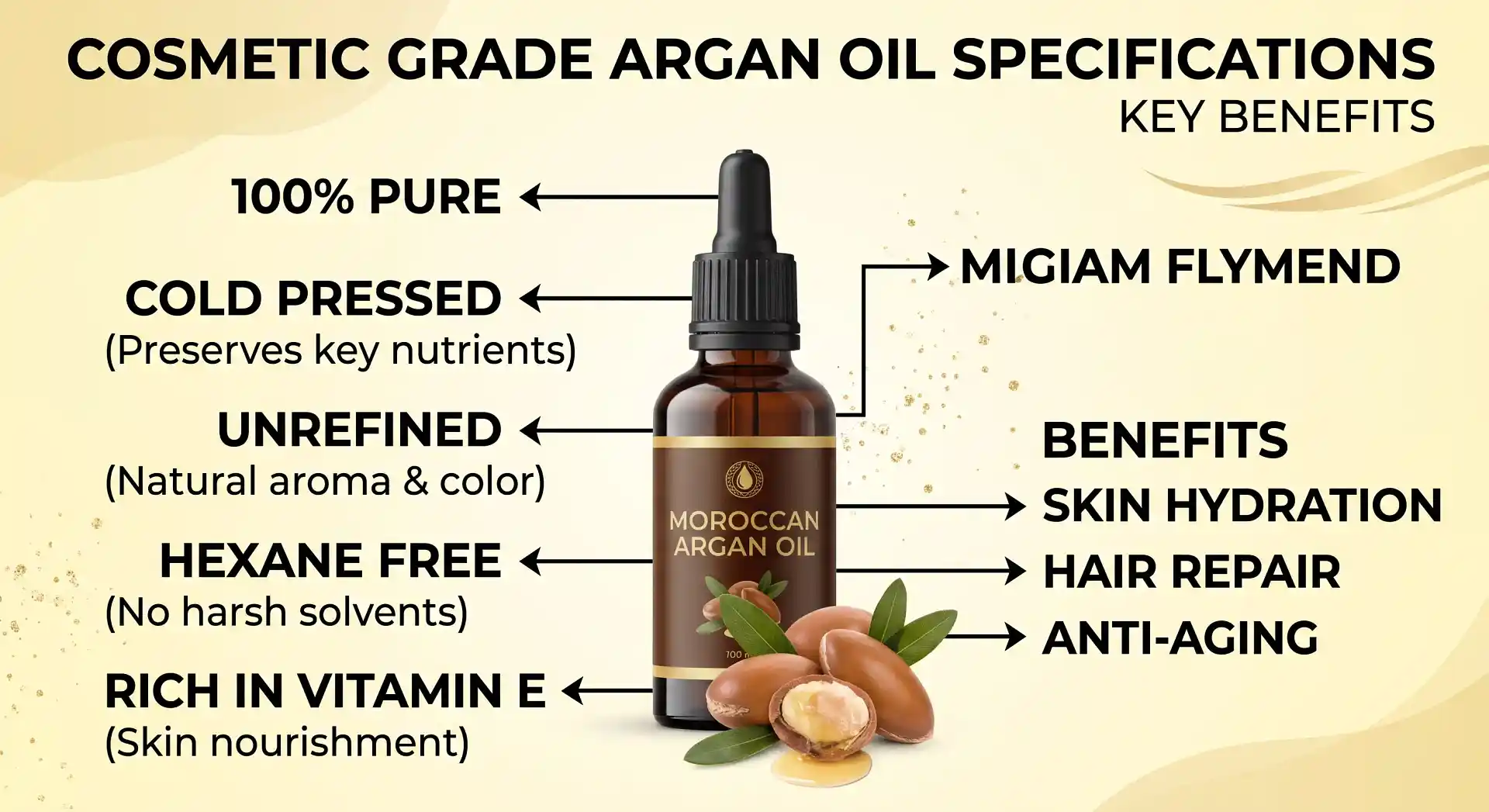
For cosmetic formulators, brand owners, and quality assurance specialists, understanding the technical specifications of cosmetic grade cold pressed argan oil (INCI: Argania Spinosa Kernel Oil) is essential. Derived from the kernels of the endemics-rich Argania spinosa tree, high-grade cosmetic argan oil must meet strict organoleptic, physical, and chemical thresholds to ensure skin safety, formulation stability, and maximum physiological efficacy.
When sourcing raw botanical oils, reviewing a comprehensive Certificate of Analysis (CoA) against international standardization benchmarks—such as Moroccan Standard SNIMA 08.5.090 and ISO standards for vegetable fats—guarantees purity and authenticity. This guide details the essential technical parameters, chemical profile ranges, and purity benchmarks required for virgin cold-pressed argan oil formulated for personal care applications.
1. Organoleptic & Physical Specifications
Organoleptic evaluations provide the first line of assessment for raw argan oil quality. Unlike culinary argan oil, where kernels are roasted prior to pressing, cosmetic argan oil is cold-pressed directly from unroasted raw kernels to preserve heat-sensitive bioactive compounds like tocopherols and essential fatty acids.
| Parameter | Cosmetic Grade Specification | Method / Standard |
|---|---|---|
| Appearance | Clear, slightly viscous liquid at room temperature (20°C) | Visual Inspection |
| Color | Light golden yellow to bright yellow (LoviBond yellow/red scale) | Visual / Colorimeter |
| Odor | Faint, characteristic nutty/earthy aroma (free from rancidity or heavy roast) | Olfactory Assessment |
| Solubility | Insoluble in water; soluble in lipophilic solvents and fixed oils | Standard Solubility Testing |
| Density / Specific Gravity (20°C) | 0.910 – 0.918 g/cm³ | ISO 6883 / Pycnometer |
| Refractive Index (20°C) | 1.468 – 1.472 | ISO 6320 / Refractometer |
A dark orange or dark brown hue typically indicates roasted seeds intended for culinary use, which alters the fatty acid integrity and produces a strong nut odor unacceptable in subtle cosmetic formulations. Conversely, a completely water-white liquid with zero aroma often points to harsh chemical refining, bleaching, or deodorization (RBD), which strips valuable unsaponifiable matter.
2. Chemical & Quality Parameters
Chemical testing establishes the freshness, oxidation state, and structural stability of the oil. Excess oxidation leads to early degradation, unpleasant rancid smells, and skin irritation in finished cosmetic products.
Free Fatty Acids (Acid Value)
Free Fatty Acid (FFA) content measures the hydrolytic breakdown of triglycerides into free fatty acids, expressed as percentage of oleic acid. For high-purity virgin cosmetic argan oil, the standard requirement is:
- Acid Value: ≤ 1.5 to 2.0 mg KOH/g
- Free Fatty Acids (% Oleic): ≤ 0.8% to 1.0% max
Lower acid values signal careful harvest management, immediate extraction following fruit depulping, and clean processing conditions.
Peroxide Value (PV)
Peroxide Value measures primary oxidation products (hydroperoxides). Because unsaturated fatty acids degrade upon exposure to air, light, and heat, PV is a crucial quality indicator during storage and shelf-life determination.
- Virgin Cold-Pressed Benchmark: ≤ 5.0 meq O₂/kg at time of manufacture
- Maximum Acceptable Limit: ≤ 10.0 meq O₂/kg (per ISO 3960 standards for vegetable fats)
Saponification & Unsaponifiable Matter
- Saponification Value: 189 – 199 mg KOH/g (ISO 3657). Essential for calculating alkalis when formulating cold-process soaps or emulsions.
- Unsaponifiable Matter: 1.0% – 1.5% max (ISO 3596). Argan oil boasts a high unsaponifiable fraction rich in phytosterols, squalene, and triterpene alcohols, which deliver deeply moisturizing skin benefits compared to lower-grade lipids.
3. Fatty Acid Composition (Gas Chromatography)
Gas chromatography (GC) profile testing according to ISO 12966 standards confirms lipid identity and guards against adulteration. Argan oil features a balanced ratio of monounsaturated (oleic) and polyunsaturated (linoleic) fatty acids, making it lighter and faster-absorbing than highly saturated plant oils.
| Fatty Acid Name | Carbon Structure | Standard Standard Range (%) |
|---|---|---|
| Oleic Acid | C18:1 (Omega-9) | 43.0% – 49.0% |
| Linoleic Acid | C18:2 (Omega-6) | 29.0% – 36.0% |
| Palmitic Acid | C16:0 (Saturated) | 11.5% – 15.0% |
| Stearic Acid | C18:0 (Saturated) | 4.5% – 7.0% |
| Alpha-Linolenic Acid | C18:3 (Omega-3) | < 0.5% |
| Gadoleic / Eicosenoic Acid | C20:1 | < 0.5% |
Deviations in these ranges strongly suggest adulteration with cheaper botanical oils like soybean, sunflower, or palm oil. Formulators interested in analyzing botanical oil purity testing procedures can review our detailed analysis on how to spot fake argan oil through purity testing.
4. Bioactive Phytochemical Profile
The skin conditioning and antioxidants benefits of cold-pressed argan oil stem from its dense micronutrient profile:
Tocopherols (Vitamin E)
Total tocopherol content ranges between 600 to 900 mg/kg. Gamma-tocopherol comprises up to 80–90% of the total tocopherol fraction, presenting stronger antioxidant shield capacity against lipid peroxidation than alpha-tocopherol alone.
Phytosterols
Argan oil contains a distinct sterol composition rare in other plant oils, notably rich in Schottenol (44–49%) and Spinasterol (34–44%). Standard plant oils typically contain high levels of Beta-sitosterol, so detecting high proportions of Schottenol and Spinasterol serves as a chemical marker for true Argania spinosa.
"The unique presence of spinasterol and schottenol in cold-pressed argan oil serves as an indisputable chemical signature for authenticity verification in gas chromatography analytical testing."
5. Cold-Press Extraction Parameters
To retain the official "Extra Virgin Cold Pressed" designation for cosmetic application, mechanical extraction must strictly control physical variables:
- Temperature Control: Mechanical expeller pressing temperatures must remain strictly below 50°C (122°F). Thermal spikes alter protein composition and destroy natural tocopherols.
- Solvent Usage: 100% mechanical pressing only. Absolutely zero chemical solvents (such as hexane) or synthetic additives may be used during extraction.
- Filtration: Physical paper or plate filtration removes particulate matter, seed sediment, and moisture down to < 0.1% moisture content without altering chemical structures.
For a detailed breakdown of raw ingredient selection, trade dynamics, and cooperative sourcing models, explore our comprehensive argan oil wholesale sourcing guide.
6. Purity, Heavy Metals, & Microbiological Limits
Because cosmetic cold pressed argan oil is an anhydrous lipid matrix, microbial growth is naturally restricted. However, quality assurance demands verification against environmental contaminants according to global safety standards such as the EU CosIng Database guidelines.
- Microbial Limits: Total Aerobic Microbial Count (TAMC) < 100 CFU/g; Total Yeast & Mold (TYMC) < 10 CFU/g; Absence of Staphylococcus aureus, Pseudomonas aeruginosa, and Candida albicans.
- Heavy Metals: Lead (Pb) < 2.0 ppm, Arsenic (As) < 1.0 ppm, Cadmium (Cd) < 1.0 ppm, Mercury (Hg) < 0.1 ppm.
- Pesticide Residues: Must comply with strict limits below quantifiable detection thresholds (LOQ) for organochlorine and organophosphorus compounds.
Evaluating cosmetic-grade ingredients side by side is common during product development; for example, brand formulators often compare argan oil specifications with luxury anti-aging lipid alternatives like in our comparative study on prickly pear seed oil versus argan oil.
7. Storage and Stability Guidelines
Unsaturated fatty acids are vulnerable to light, heat, and atmospheric oxygen. To keep parameters within CoA specification thresholds throughout a 24-month shelf life:
- Packaging: Amber glass, dark aluminum, or food-grade HDPE drums nitrogen-flushed prior to sealing.
- Temperature: Stored in cool, dry conditions between 15°C and 25°C (59°F–77°F). Avoid direct sunlight or proximity to heat sources.
- Antioxidant Fortification: While raw virgin argan oil contains stable natural tocopherols, formulators adding argan oil into leave-on serums may add 0.1% natural Vitamin E (mixed tocopherols) for extended storage.
When reviewing technical documentation for product development, ensure your supplier provides up-to-date documentation. Learn more about botanical certifications and regulatory compliance in our overview of certified argan oil quality standards and our guide to sourcing authentic raw cosmetics.
Frequently Asked Questions
What is the ideal Peroxide Value for fresh cosmetic cold pressed argan oil?
Freshly pressed cosmetic grade argan oil should typically feature a Peroxide Value (PV) under 5.0 meq O₂/kg. International standard thresholds permit up to 10.0 meq O₂/kg for virgin cosmetic oils, but lower initial values ensure a significantly longer formula shelf life.
How do specifications differ between cosmetic and culinary argan oil?
Cosmetic argan oil is cold pressed from unroasted nuts, maintaining a golden yellow hue, light nutty aroma, high unsaponifiable nutrient profile, and lower peroxide values. Culinary argan oil uses roasted kernels, resulting in a dark brownish-red oil with a strong toasted aroma that is unsuited for personal care formulations.
What free fatty acid percentage indicates high-quality cosmetic grade argan oil?
High-grade virgin cosmetic argan oil generally maintains a free fatty acid (FFA) level below 0.8% to 1.0% (calculated as oleic acid). Lower FFA indicates that kernels were healthy, processed quickly after fruit harvest, and extracted without excessive heat or moisture hydrolytic degradation.
Which test verifies that cold pressed argan oil is unadulterated?
Gas Chromatography (GC) testing of fatty acids and phytosterols is the most accurate verification method. High levels of oleic (43–49%) and linoleic (29–36%) acids combined with specific markers like Schottenol and Spinasterol confirm that the oil is pure, unadulterated Argania spinosa.