What Is a Kessa Glove Made From? Why Viscose Crepe Weave Outperforms Loofahs
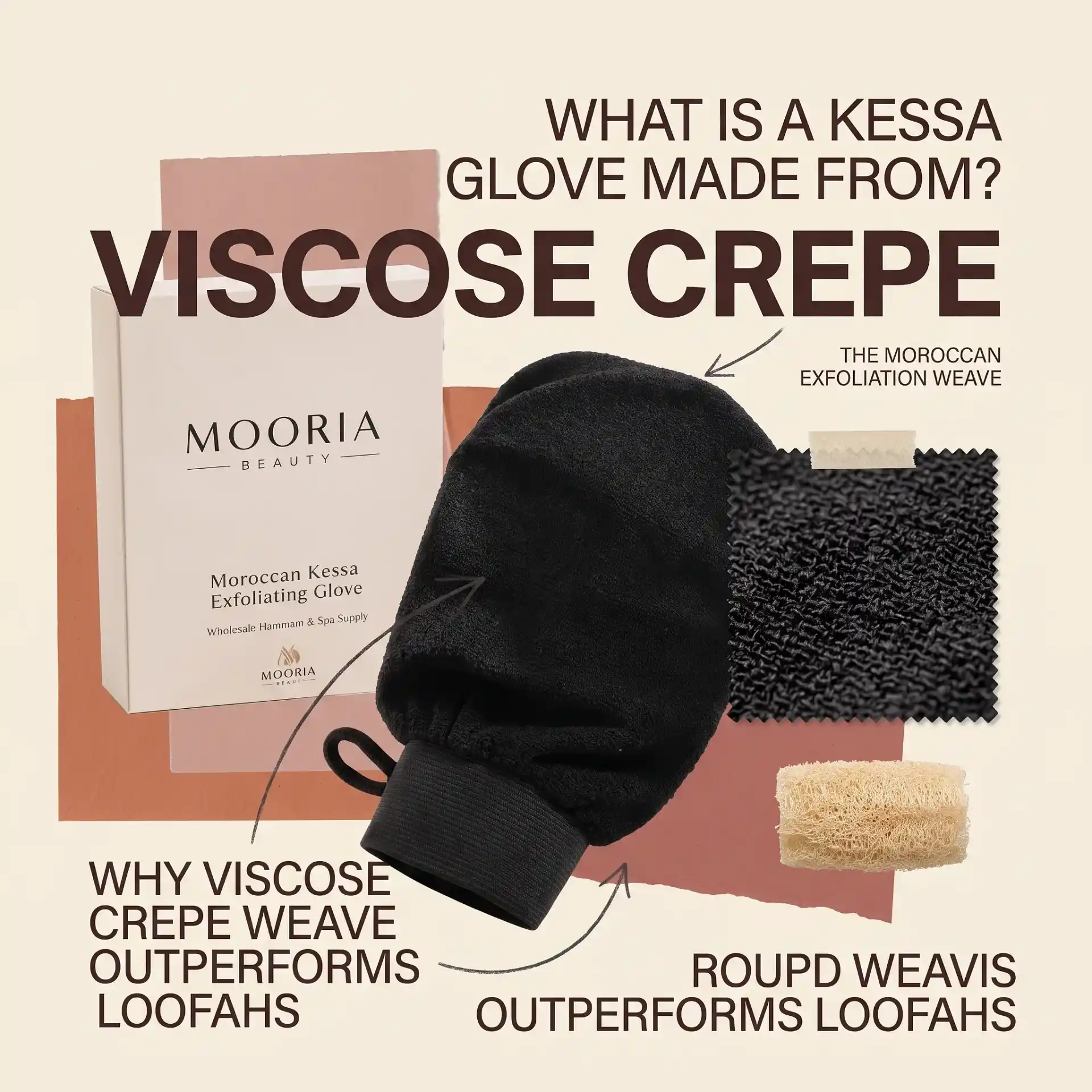
When exploring physical exfoliation tools for smooth, radiant skin, two items frequently dominate the conversation: the traditional Kessa glove and the ubiquitous loofah. While both aim to strip away accumulated dead skin cells, their material composition, tactile mechanics, and physiological effects on the skin barrier are vastly different.
At the center of the Kessa glove's legendary effectiveness is its material: 100% viscose crepe fabric. Unlike fibrous natural gourds or abrasive synthetic plastic meshes, viscose crepe is an engineered textile designed specifically to grip and roll away dead epidermal cells without scratching the underlying skin. Understanding what a Kessa glove is made from clarifies why the Kessa glove's painless dead skin removal mechanism consistently outperforms standard loofahs in both safety and performance.
What Is a Kessa Glove Made From? The Material Science
To understand why the Kessa glove works so well, one must examine its raw material and unique textile architecture. Historically, traditional Moroccan hammam exfoliating mittens were constructed from raw silk or coarse goat hair. However, modern cosmetic textile engineering has refined the tool into what is today recognized worldwide: high-density viscose crepe weave.
1. The Origin of Viscose Fiber
Viscose (often referred to as rayon) is a semi-synthetic regenerated cellulose fiber made from natural wood pulp, such as beech, pine, or bamboo. According to textile research published by the European Man-made Fibres Association (CIRFS), cellulose-based fibers retain structural traits of natural plant materials—such as high breathability and moisture absorption—while offering uniform filament strength engineered at a microscopic level.
Because viscose is derived from organic plant cellulose, it behaves differently on human skin than petroleum-based plastics like nylon or polyester. It absorbs water quickly, swelling individual fibers and softening the textile matrix so that it becomes pliable yet firm when wet.
2. The Crepe Weave Technique
The secret of the Kessa glove lies not just in the yarn, but in how that yarn is woven. "Crepe" refers to a weaving technique where yarns are given an alternating high twist (S and Z twists) during manufacturing. When the fabric is finished and exposed to moisture, these tightly twisted yarns contract irregularly.
This process creates a distinctively pebbled, micro-ridged surface texture. Rather than displaying sharp, rigid spikes, the surface features thousands of microscopic loops and ridges per square centimeter. This high-friction micro-texture is designed to latch onto loosened keratinized skin cells on the stratum corneum.
What Is a Loofah? Understanding Natural and Synthetic Variants
To evaluate why viscose crepe performs superiorly, it is important to examine the composition of common loofahs:
- Natural Loofah: Contrary to popular belief, a natural loofah is not a sea sponge. It is the dried fibrous vascular network of the Luffa aegyptiaca or Luffa acutangula gourd—a member of the cucumber family. Once dried, the intricate structural xylem yields a stiff, highly porous, fibrous cylinder.
- Synthetic Loofah (Shower Puff): Constructed from polyethylene (PE) or nylon mesh, these tools are gathered into loose, ruffled spheres designed primarily to create voluminous soap lather rather than provide mechanical exfoliation.
5 Reasons Viscose Crepe Weave Outperforms Loofahs
1. Precision Mechanical Exfoliation (The "Roll-Off" Effect)
The primary mechanical objective of body exfoliation is removing desquamated corneocytes (dead skin cells) without disrupting the viable epidermis beneath. Medical research into skin biomechanics on PubMed demonstrates that uncontrolled physical friction can induce micro-lacerations, precipitating transepidermal water loss (TEWL) and localized inflammation.
When wet, viscose crepe contracts and forms a micro-abrasive plane. When pressed firmly against damp skin, it generates a unique shearing force. Rather than grinding into the skin surface, the crepe weave creates friction against dry keratin scales, causing dead skin to roll up into visible gray cylinders. In contrast, natural loofah fibers feature sharp, uneven woody ridges that scratch unevenly across the skin, while synthetic plastic puffs merely slide across the skin surface using soap lubrication.
For a detailed breakdown of tool physics, consult our comparison guide on chemical vs. physical exfoliation with exfoliating body gloves.
2. Superior Hygiene and Microbial Resistance
One of the most compelling arguments for replacing a loofah with a viscose Kessa glove is hygiene. The dense, three-dimensional matrix of a natural loofah retains water within deep internal chambers. Combined with warm bathroom environments, residual soap scum, and shed skin debris, loofahs create ideal breeding grounds for bacteria and fungi.
A landmark study published in the Journal of Clinical Microbiology revealed that natural loofah sponges serve as reservoirs for species such as Pseudomonas aeruginosa, Acinetobacter, and Xanthomonas, which can cause folliculitis and skin infections when rubbed into micro-abrasions.
By contrast, a viscose crepe Kessa glove is a single-layer, flat-woven textile. Because it lacks thick internal padding or cavernous pores, it drains water almost instantly and dries rapidly when hung in an airy space. This flat design drastically minimizes bacterial colonization and allows for thorough washing between uses.
3. Surface Uniformity and Texture Control
Because natural loofahs grow as biological gourds, their fiber density varies throughout the sponge. One side may feature soft, yielding strands while another harbors thick, woody stems capable of scratching delicate skin. Synthetic mesh poofs offer consistency, but their smooth plastic loops lack the tactile grit required for deep desquamation.
Viscose crepe fabric is manufactured with textile precision. Every millimeter of the Kessa glove provides identical tactile resistance, ensuring an even exfoliation process across broad areas like the back, thighs, and arms without unpredictable rough spots.
4. Targeted Action for KP and Ingrowing Hairs
For individuals dealing with stubborn follicular conditions like Keratosis Pilaris (KP) or plugged pores on the legs, texture selection is critical. KP occurs when keratin builds up and forms hard plugs inside hair follicles.
Natural loofahs are often too coarse, inflaming surrounding tissue while failing to extract the plug. Synthetic mesh puffs lack the structural bite needed to dislodge dense keratin accumulations. The micro-grain ridges of a wet viscose Kessa glove effectively grasp and lift keratin plugs from follicle openings. For targeted management strategies, read our guides on how to treat keratosis pilaris naturally with Moroccan exfoliation and how to get rid of strawberry legs fast.
5. Friction Mechanics: Water-Activated vs. Soap-Lathered
Loofahs and shower poofs require heavy soap lathers to function smoothly; without soap, a dry or wet natural loofah drags roughly across the skin. However, soap lather acts as a lubricant that neutralizes mechanical friction, preventing real dead skin removal.
A viscose crepe Kessa glove operates under a completely different paradigm. It relies strictly on **water activation and friction**. It works best after the skin has been softened with steam or warm water and cleansed of oils. Once rinsed, the bare, damp viscose crepe grabs surface debris directly rather than slipping over a layer of suds. To master this technique, explore our step-by-step instructions on how to use a Moroccan Kessa exfoliating glove.
Comprehensive Comparison Table
| Feature / Attribute | Kessa Glove (Viscose Crepe) | Natural Loofah (Gourd) | Synthetic Mesh Puff |
|---|---|---|---|
| Material Source | 100% Plant Cellulose (Viscose) | Dried Luffa Plant Matrix | Polyethylene / Nylon Plastic |
| Texture Mechanism | High-twist crepe micro-grain weave | Irregular natural vascular fibers | Smooth extruded plastic net loops |
| Exfoliation Action | Grips and rolls dead skin away | Scrapes surface with varied fiber hardness | Light surface buffing; minimal peel |
| Bacterial Retention Risk | Low: Flat, fast-drying single layer | High: Deep porous inner cavities hold moisture | Moderate: Multi-layered core trap water |
| Skin Barrier Safety | High uniform precision; non-lacerating | Variable; potential micro-scratches | Gentle, but prone to over-rubbing |
| Primary Soap Requirement | Water-only friction (post-cleansing) | Requires thick soap/gel lather | Requires liquid body wash for foam |
| Lifespan & Care | 3–6 months; easily washable & hang-dried | 3–4 weeks before mold accumulation | 1–2 months before mesh unravels |
Care and Maintenance of Viscose Crepe Mittens
Because viscose is a cellulose-derived fiber, proper maintenance extends the life of your Kessa glove and preserves the structural integrity of the crepe weave:
- Rinse Thoroughly: After every session, rinse the mitten with warm water to remove all trapped corneocytes and residual soap.
- Air Dry Completely: Wring out excess water gently and hang the glove in a dry, ventilated area outside the humid shower stall. Rapid drying keeps the fiber matrix crisp and prevents mold growth.
- Avoid Harsh Bleach or Boiling Water: Extreme heat or chlorine bleach breaks down regenerated cellulose fibers, compromising the crepe twist and softening the necessary micro-grain surface.
- Replace Periodically: Even high-grade viscose crepe naturally loses its twist elasticity over time. Replace your Kessa mitten every 3 to 6 months to maintain optimal friction performance.
Frequently Asked Questions
Is a Kessa glove made of plastic or synthetic material?
No. Standard high-quality Kessa gloves are made from 100% viscose, a fiber derived from natural plant cellulose (wood pulp). While processing transforms cellulose into filament threads, it is not a petroleum plastic like nylon or polyester.
Why does a Kessa glove feel smooth when dry, but textured when wet?
When exposed to water, viscose fibers absorb moisture and swell. Combined with the high-twist crepe weave, this swelling causes the fabric matrix to tighten and shrink slightly, transforming the flat fabric into a firm, micro-textured exfoliating tool.
Can I use soap directly on the Kessa glove while exfoliating?
It is not recommended. Soap creates a lubricated barrier that prevents the crepe weave from grabbing dead skin cells. For best results, wash your body first with a moisturizing cleanser or traditional black soap, rinse off completely, and then use the damp Kessa glove with clean water only.
How often should I replace a viscose Kessa glove compared to a loofah?
Natural loofahs should be discarded every 3 to 4 weeks due to rapid bacterial buildup within their porous cavities. A viscose Kessa glove, which dries quickly and can be thoroughly sanitized, typically lasts 3 to 6 months before the crepe weave loses its exfoliation firmness.