Moroccan Black Soap on Face: The 3-Minute Rule
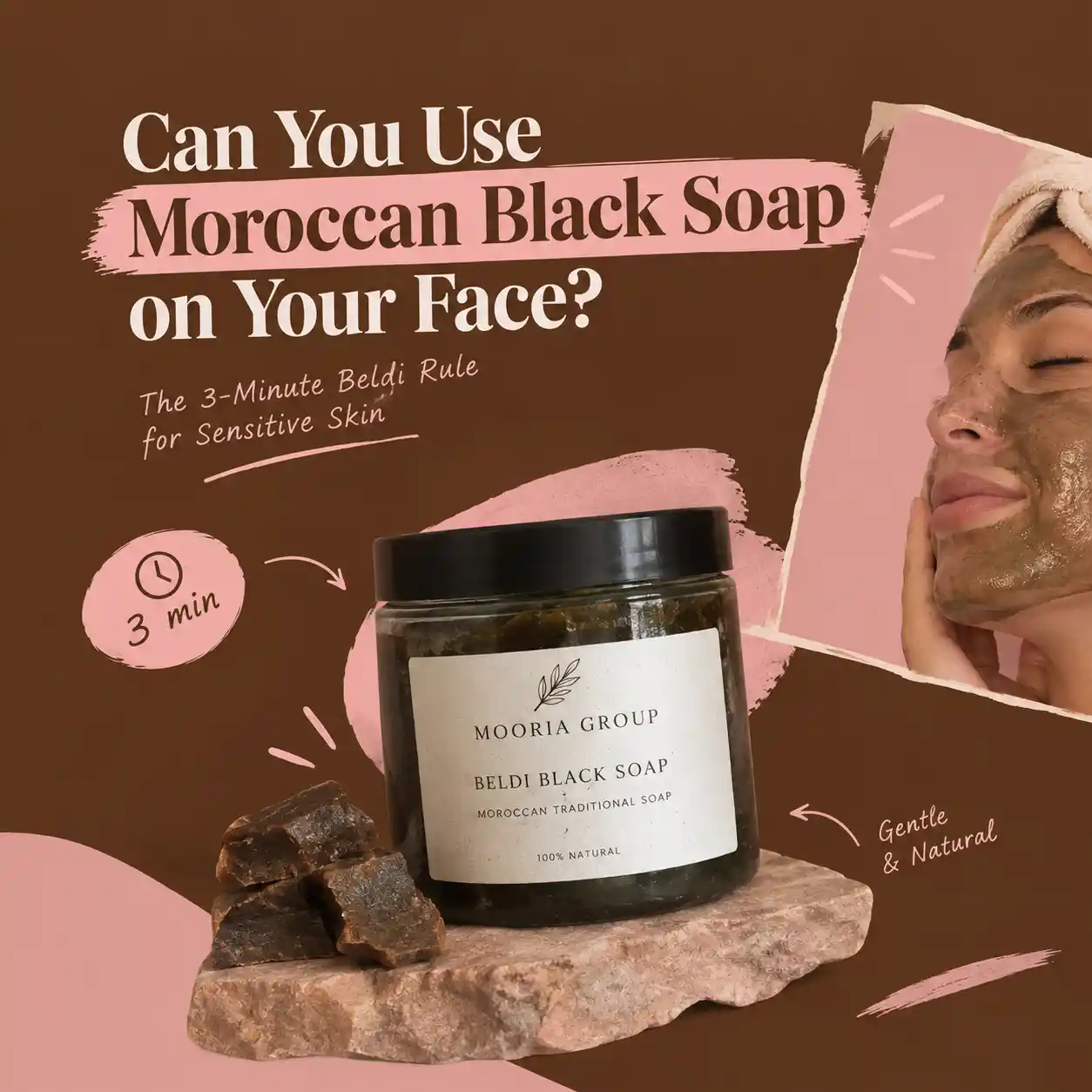
Moroccan Black Soap, known locally as Beldi soap, has built a reputation as one of the most effective natural exfoliants around. But when it comes to the face — especially sensitive skin — the enthusiasm often runs ahead of the caution. Can you actually use it on your face? The short answer is yes, but not the way most people use it on their body.
This guide explains what Beldi soap is, why it can be safe for facial skin, and introduces a simple timing rule that keeps its benefits without the irritation risk.
What Is Moroccan Black Soap (Beldi Soap)?
Beldi soap is a traditional Moroccan paste made primarily from crushed black olives and olive oil, sometimes blended with other natural ingredients depending on the region and recipe. Unlike Western bar soaps, it has a soft, almost gel-like texture and no synthetic detergents. For a full breakdown of its ingredients and how it's traditionally produced, see our guide on
It has been used for generations in Moroccan hammams, typically applied to the whole body before scrubbing with a kessa glove to remove dead skin. That full-body ritual is where most of the confusion about facial use comes from — the body routine is simply too intense for facial skin.
Is Moroccan Black Soap Safe for the Face?
Yes, in general Beldi soap is considered safe for facial use, including for many people with sensitive skin — but with important adjustments. Its natural composition tends to be gentler than synthetic exfoliants, and because it contains no harsh sulfates, it doesn't strip the skin barrier the way many commercial face washes do. Our overview on
That said, "safe" doesn't mean "use it exactly like you would on your body." The face has thinner, more reactive skin, particularly around the cheeks and under the eyes, which is why timing and technique matter far more here than anywhere else on the body.
Why Sensitive Skin Needs a Different Approach
Sensitive skin reacts faster and more visibly to friction, prolonged contact, and active ingredients than skin on the arms, legs, or back. Three factors make facial application riskier if done incorrectly:
Thinner epidermis: The face has less protective buildup than body skin.
Higher nerve density: Irritation shows up faster as redness or stinging.
More exposure: Facial skin is already dealing with sun, pollution, and skincare actives.
This is also why formulations matter. A soap blended with soothing or purifying botanicals — such as
The 3-Minute Beldi Rule
This is the simplest way to get the exfoliating and cleansing benefits of Beldi soap on your face without triggering dryness, redness, or micro-irritation. The rule has three parts, and the name comes from the single most important number in the whole routine: leave-on time.
Apply a thin layer and wait, don't rub. Warm the soap slightly between your fingers, apply a thin layer to damp skin, and let it sit — do not scrub it in the way you would on the body.
Cap the contact time at 3 minutes. Three minutes is enough for the soap's natural compounds to loosen dead skin and impurities without over-softening the skin barrier. Leaving it longer — a common habit carried over from body use — is the single biggest cause of facial irritation.
Rinse with lukewarm water using light circular motions. Only at the rinsing stage should you use gentle circular motion with your fingertips, never a kessa glove or exfoliating cloth on facial skin.
Follow immediately with a fragrance-free moisturizer to lock in hydration, since even a gentle cleanse temporarily loosens the skin's natural lipid layer.
How Often Should You Use It on Your Face?
For most sensitive skin types, once or twice a week is the safer starting frequency, rather than the daily or every-other-day use common for body application. This gives the skin barrier time to recover between sessions while still delivering noticeably smoother, clearer-looking skin over a few weeks.
Sensitive or reactive skin: Once a week, strictly under 3 minutes.
Normal or combination skin: Up to twice a week.
Oily or congested skin: Twice a week, paired with a purifying variant if needed.
Signs the 3-Minute Rule Isn't Being Followed
If facial use of Beldi soap is causing problems, it's rarely the soap itself — it's usually the timing or the leftover habits from body use. Watch for:
Tightness or a squeaky-clean feeling immediately after rinsing
Redness that lasts more than a few minutes
Flaking appearing within a day or two of use
Increased sensitivity to your regular moisturizer or serum afterward
Any of these signs usually mean the soap was left on too long, applied too often, or paired with physical scrubbing that belongs on the body, not the face.
Choosing the Right Black Soap for Facial Use
Not all Beldi soaps are formulated the same way, and for facial use it's worth choosing a variant designed with skin-soothing or antioxidant-rich additions rather than the most concentrated traditional paste. A blackberry-infused Beldi soap, for example, adds antioxidant support while keeping the same gentle olive-based base — you can see the
Frequently Asked Questions
Can Moroccan Black Soap be used on sensitive facial skin?
Yes, when contact time is limited to around 3 minutes and it's applied without vigorous scrubbing. Longer contact or a kessa glove on the face is what typically causes irritation, not the soap itself.
How long should I leave black soap on my face?
Roughly 3 minutes is the general guideline for facial skin, compared to longer soaking times often used on the body.
Can black soap dry out the face?
It can if left on too long, used too frequently, or followed without a moisturizer. Used correctly, most people find it cleanses without the tight, stripped feeling of harsher facial cleansers.
Is a kessa glove safe to use on the face?
No. Kessa gloves are designed for body exfoliation and are generally too abrasive for facial skin. Rinse facial applications with fingertips only.
How often should sensitive skin use Moroccan Black Soap?
Once a week is a reasonable starting point for sensitive skin. This can be adjusted upward gradually if the skin tolerates it well.
Final Thoughts
Moroccan Black Soap can absolutely be part of a facial routine, including for sensitive skin — the traditional body ritual just needs to be scaled down. The 3-minute rule, gentle fingertip application, and a suitable formulation are what separate a soothing weekly cleanse from an irritated, over-exfoliated face.